Author’s note:
This post is based on a formative essay written for GY473 – Economic Development and the Environment (2025/26), taught by Prof. Charles Palmer and Prof. Giles Atkinson. The essay responded to the question: “All countries produce GDP estimates, but few measure wealth.” Critically discuss this statement, and whether growth in GDP should be the key objective of economic development policy.
Written under closed-book exam conditions, the essay draws on course material from memory and deliberately engages critically with degrowth and natural capital frameworks, examining their political and developmental implications.
GDP Growth, Sustainability, and Unequal Trade-offs
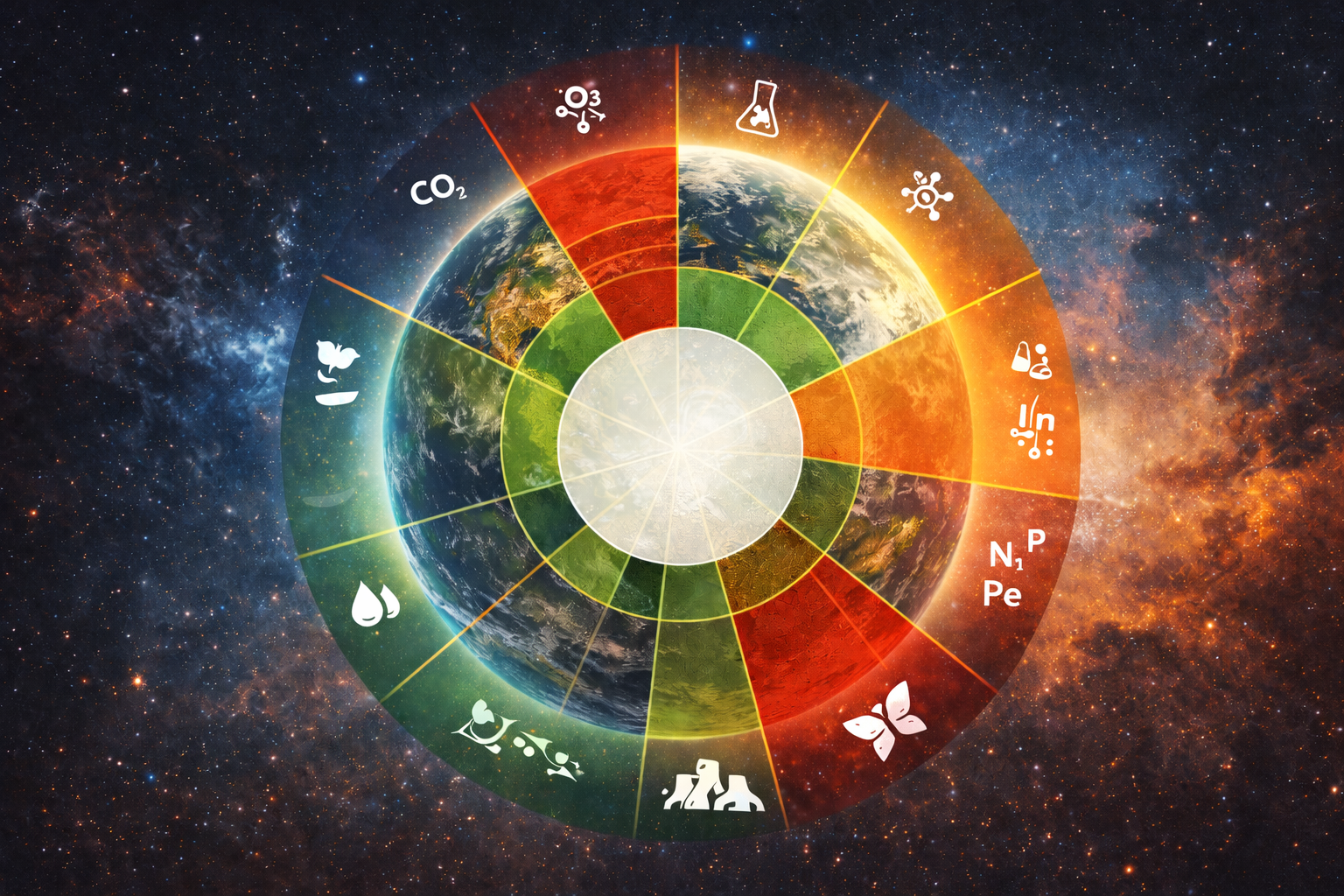
Economic development is commonly understood as a sustained improvement in living standards, including income, economic security, and access to basic services. In policy debates, it is most often proxied by growth in gross domestic product (GDP), a measure of economic output rather than long-term economic capacity or wealth. Increasingly, however, critics argue that GDP growth fails to capture environmental degradation and the depletion of natural capital, giving rise to alternative frameworks such as degrowth and the “spaceship economy,” both of which seek to align economic activity more closely with planetary boundaries.
This essay argues that while degrowth and spaceship economy models raise important concerns about environmental limits, both face significant constraints in political feasibility and risk imposing disproportionate costs on economies in the Global South. While economic development and environmental protection frequently reinforce one another, and doing so should remain the primary policy objective, large-scale frameworks such as degrowth and the spaceship economy tend to underplay important areas of friction between these goals. Failing to take these tensions seriously risks imposing growth constraints on countries in the Global South that still depend on economic expansion to achieve convergence. In such contexts, the essay argues that the Global North has a moral obligation to prioritise global economic convergence while pursuing environmental protection wherever possible. Finally, it contends that supporting innovation in manufacturing and service provision in the Global South offers the most politically feasible and ethically defensible path for combining economic development with climate change mitigation.
The Interdependence Problem of Degrowth
Degrowth, most prominently associated with Jason Hickel, seeks to address one of the central political and economic challenges of the twenty-first century. It asks the question how to sustain or raise living standards, particularly in the Global South, without crossing irreversible environmental tipping points. At its core, the degrowth agenda questions whether continued expansion of economic output in high-income countries is compatible with planetary boundaries.
In Hickel’s formulation, degrowth calls for a “reduction of aggregate commodity production in high-income nations to reduce energy and resource throughput,” while arguing that social value and well-being can be improved even as material production declines (Hickel and Hallegatte 2021). Stephan Hallegatte, however, challenges this position by emphasising its political infeasibility. He argues that modern welfare states, labour markets, and fiscal systems remain deeply dependent on economic growth, and that deliberate contraction would face strong political resistance. Instead, Hallegatte proposes redefining growth by incorporating natural capital into economic accounting and focusing on decoupling material extraction from GDP, achieving more economic value per unit of resource use through efficiency gains.
Edward Barbier (2022) enters this debate by introducing the distinction between a “cowboy economy” and a “spaceship economy.” He argues that prevailing growth models implicitly assume limitless resources, whereas the spaceship economy recognises ecological constraints and calls for a fundamental reorientation of economic activity to remain within planetary limits.
Degrowth in an Integrated World Economy
Despite their differences, both degrowth and spaceship economy frameworks face similar limitations when applied within a highly interconnected global economy. While degrowth is primarily intended to constrain growth in high-income countries rather than in the Global South, its effects are unlikely to remain geographically contained. In an integrated global system, slower growth in advanced economies is likely to spill over through reduced demand for exports, weaker investment flows, and lower fiscal capacity for development finance and technology transfer. For countries that rely on access to external markets and capital to finance industrialisation, poverty reduction, and public investment, such spillovers may impose significant constraints on development prospects (Getachew 2019).
Moreover, prolonged growth slowdowns in high-income democracies may generate political backlash, increasing support for protectionist or nationalist policies that further restrict trade, migration, and international cooperation (Rodrik 2011). Recent assessments also suggest that the empirical foundations of degrowth remain contested, with much of the supporting literature relying on limited evidence or stylised assumptions, raising doubts about its suitability as a global policy framework (Savin and van den Bergh 2024).
The Measurement and Power Problem of Natural Capital
Barbier’s proposal to redefine GDP to include natural capital, while arguably less radical than degrowth, raises related concerns. Incorporating natural capital into GDP could, in principle, incentivise environmental protection and slow climate change and biodiversity loss. Barbier bases this argument on the claim that ecosystems account for roughly half of the value generated in the global economy (Barbier 2022). Ecosystem services such as water provision, carbon sequestration, and climate regulation are undeniably essential for economic activity, yet remain largely invisible in standard national accounts.
However, this approach faces significant conceptual and practical challenges. Many ecosystem services are non-excludable, jointly produced, and lack clear marginal units, making their valuation highly uncertain. Unlike manufacturing or service provision, the “inputs” used to generate ecosystem services are difficult, if not impossible, to observe or price, complicating efforts to measure their contribution to economic output. Moreover, ecosystem services and natural capital are far less subject to productivity-enhancing innovation than manufacturing or services. For these reasons, it is more realistic to treat ecosystem services as analogous to commodity extraction rather than as dynamic service sectors. This distinction matters because economic structure plays a key role in shaping countries’ bargaining power and long-term development prospects.
Since a large share of global natural capital is located in the Global South, incorporating it into GDP would likely prioritise the protection of this sector over industrial and service-based development, an environmentally desirable outcome. Yet commodity-based economies are historically associated with deteriorating terms of trade, as described by the Prebisch–Singer hypothesis. As a result, such a shift risks reinforcing existing patterns of divergence between resource-dependent economies and those centred on manufacturing and high-value services (Lin 2011; Chang 2002, 2020).
The Spaceship Economy and the Politics of Scarcity
Furthermore, the political implications of a spaceship economy are also problematic. Treating global resources as strictly finite transforms the international economy from a positive-sum system into one characterised by zero-sum game. In the absence of effective global governance, competition over scarce resources is likely to intensify, with developing countries, already weaker in global bargaining hierarchies, disproportionately affected (Rodrik 2011). As common interests erode and informal institutions weaken, such competition risks fostering conflict and a more hostile international environment (Ostrom 1990).
The Developmental Case for Economic Growth
Historical evidence suggests that sustained growth in national GDP remains the most reliable mechanism for raising living standards over time (Allawi 2024; Collier 2007; Gallup, Sachs and Mellinger 1999; Sachs 2012). While the marginal benefits of additional growth diminish at very high income levels, GDP expansion continues to play a central role in poverty reduction, employment creation, and fiscal capacity in low- and middle-income countries. Given that global wealth disparities and power asymmetries are deeply rooted in colonial extraction and unequal integration into the world economy, the Global North carries a moral responsibility to prioritise global economic convergence.
Both degrowth and spaceship economy frameworks risk undermining this objective. At the same time, there is no denying that continued economic growth, if pursued without constraint, raises the probability of biodiversity loss and the irreversible acceleration of climate change (UNEP 2021). The policy challenge therefore lies not in denying environmental risks, but in determining how they should be weighed against the ethical imperative of development.
Climate Risk, Development, and Moral Obligation
There are two key reasons why global economic convergence should take precedence when such trade-offs arise. First, the majority of cumulative greenhouse gas emissions and environmental degradation were generated during the historical development of high-income countries. It is therefore ethically problematic to ask the Global South to bear the costs of avoiding environmental tipping points to which it contributed relatively little. Second, higher levels of economic development increase adaptive capacity and resilience, particularly in regions that are most exposed to climate-related shocks. Economic growth expands the fiscal and institutional resources needed to invest in climate adaptation, disaster response, and long-term risk mitigation. While there remains considerable uncertainty over how to effectively mitigate environmental destruction without imposing economic costs on low-income countries, there is far less uncertainty about the fact that these countries already face, and will continue to face, the environmental consequences of past emissions largely generated by the Global North. Under these conditions, there is a strong moral obligation to ensure that vulnerable countries are economically equipped to protect themselves against risks they did little to create.
Climate Policy as Power Politics
Finally, the Global North has a responsibility to promote forms of environmental policy that complement, rather than constrain, development in the Global South. Many measures framed as necessary for environmental protection, such as border carbon adjustments, risk aligning more closely with the interests of advanced economies than with those of developing countries (Cosbey et al. 2020). By contrast, investments in sustainable industrialisation and innovation in manufacturing and service provision can simultaneously support growth and reduce environmental harm. Policies that expand productive capacity while lowering emissions intensity represent a more credible path toward both global convergence and climate mitigation (Gravett 2020).
Development, Sustainability, and Moral Choice
To conclude, when moral responsibility and political feasibility are taken seriously, GDP should remain a central measure of economic development, and GDP growth should remain a central policy instrument, while its expansion is prioritised in the Global South and pursued through environmentally sustainable means. Although alternative frameworks rightly highlight ecological limits, they often underestimate the distributive and political consequences of constraining growth in an unequal global economy. A development strategy that supports economic convergence through innovation, industrialisation, and resilience-building offers a more just and realistic path forward, one that acknowledges environmental risks without shifting their costs onto those least responsible for creating them.
References:
Allawi, A. A. (2024). The crisis of development in the Middle East. Yale University Press.
Barbier, E. B. (2022). Economics for a fragile planet. Cambridge University Press.
https://doi.org/10.1017/9781108972463
Chang, H.-J. (2002). Kicking away the ladder: Development strategy in historical perspective. Anthem Press.
Chang, H.-J. (2020). Edible economics: A hungry economist explains the world. PublicAffairs.
Collier, P. (2007). The bottom billion: Why the poorest countries are failing and what can be done about it. Oxford University Press.
Cosbey, A., Droege, S., Fischer, C., & Munnings, C. (2020). Developing guidance for implementing border carbon adjustments: Lessons, cautions, and research needs. Energy Policy, 137, 111058.
https://doi.org/10.1016/j.enpol.2019.111058
Gallup, J. L., Sachs, J. D., & Mellinger, A. D. (1999). Geography and economic development. International Regional Science Review, 22(2), 179–232.
https://doi.org/10.1177/016001799761012334
Getachew, A. (2019). Worldmaking after empire: The rise and fall of self-determination. Princeton University Press.
Gravett, W. (2020). Industrialisation and sustainable development in the Global South.
Hickel, J., & Hallegatte, S. (2021). Can we live within environmental limits and still reduce poverty? Degrowth or decoupling? Development Policy Review, 40(1).
https://doi.org/10.1111/dpr.12584
Lin, J. Y. (2011). New structural economics: A framework for rethinking development. World Bank.
Ostrom, E. (1990). Governing the commons: The evolution of institutions for collective action. Cambridge University Press.
Rodrik, D. (2011). The globalization paradox: Democracy and the future of the world economy. W. W. Norton & Company.
Sachs, J. D. (2012). The price of civilization: Reawakening American virtue and prosperity. Random House.
Savin, I., & van den Bergh, J. C. J. M. (2024). Reviewing studies of degrowth: Are claims matched by data, methods and policy analysis? Ecological Economics, 226, 108324.
https://doi.org/10.1016/j.ecolecon.2024.108324
United Nations Environment Programme. (2021). Making peace with nature: A scientific blueprint to tackle the climate, biodiversity and pollution emergencies. UNEP.
https://www.unep.org/resources/making-peace-nature
