A summary of Murat Arsel's lecture on carbon capitalism, energy transitions, and what comes next delivered at the Cumberland Lodge weekend organized by the Development Department in February 2026.
Ecuador After Oil
Murat Arsel opens with a striking anecdote from Ecuador’s city that renamed itself after an oil company, using the proceeds to build an airport. The town's population is overwhelmingly male, drawn there by oil extraction jobs. Sitting at this airport the researcher started to formulate a question for climate policy: if we take climate change mitigation seriously, all of this disappears – the airport, the jobs, the economic foundation of the community. What happens to Ecuador when oil extraction stops globally?
This question extends far beyond Ecuador. Nigeria, the Democratic Republic of Congo, Saudi Arabia, many developing countries have built their economies around fossil fuel extraction. While climate change mitigation is ostensibly ‘for’ developing countries, many are simultaneously deeply dependent on the very industries that must be phased out. Arsel's lecture examines this tension through both theoretical frameworks and empirical observation, asking: what happens to these countries in a post-carbon world?
The Persistence of Carbon Capitalism
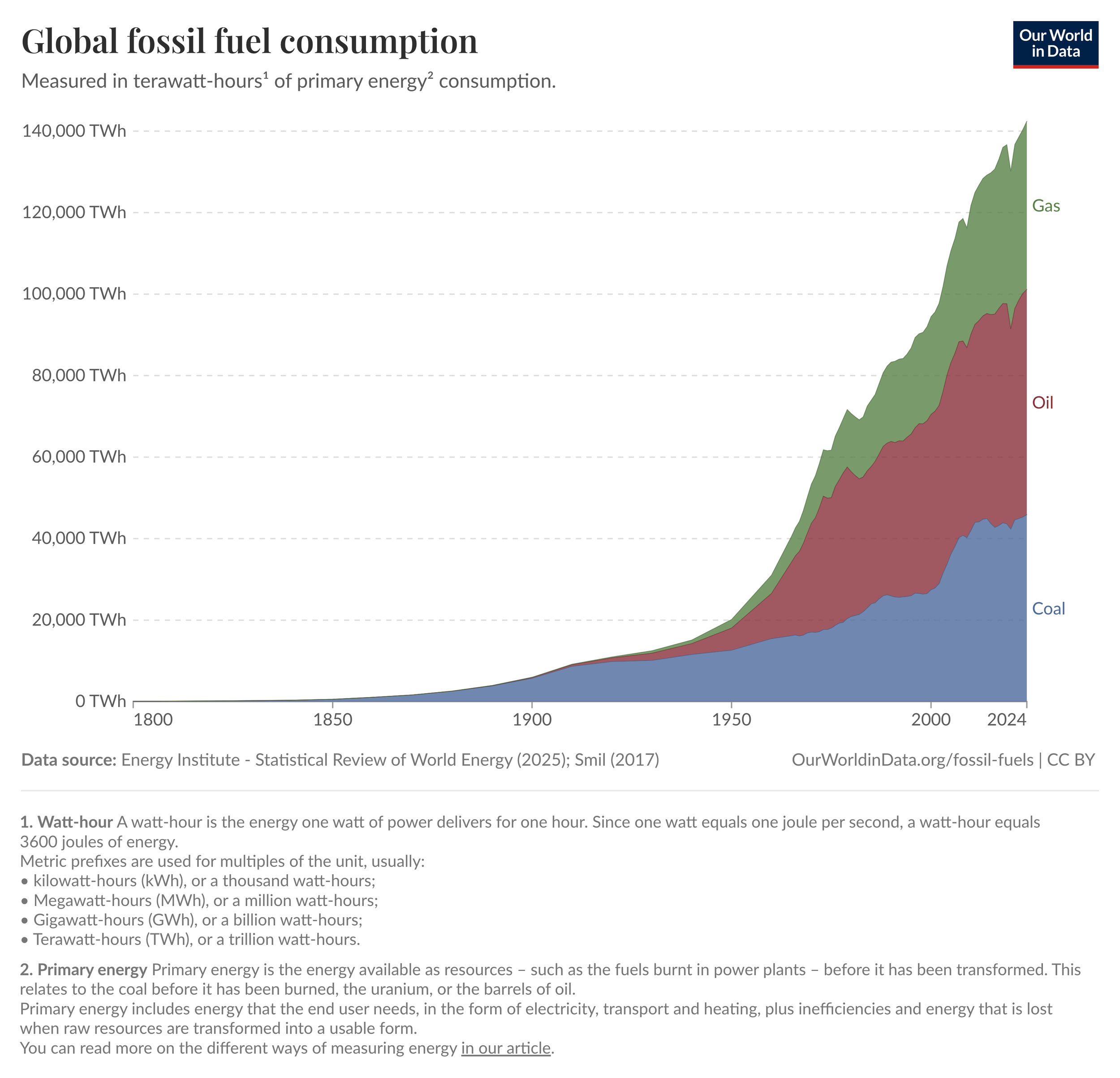
Arsel begins by establishing that capitalism is heavily dependent on fossil fuel consumption for its energy needs. He notes that the type of dominant energy source carries profound political economic implications. The economy and culture of countries look fundamentally different based on what powers them. He points to coal consumption and the UK's transition away from it as a factor contributing to Brexit, illustrating how energy systems shape political outcomes.
Despite decades of environmental protests and policy-making, global fuel consumption has continued to increase. Arsel highlights that historically, energy transitions have been additive, not substitutive. The shift from coal to oil, from oil to natural gas, these were additions to the energy mix rather than replacements (with the exception of biomass). This means that carbon emissions have risen regardless of the policies implemented. Perhaps they would have been worse without intervention, but from a climate perspective, the trajectory remains deeply troubling.
As a result, CO2 concentrations in the atmosphere are at levels unprecedented in the past million years. The goal is to stabilize between 1.5 and 2 degrees, but we've already missed the 1.5-degree target, and our final landing point - and its consequences - depend entirely on where we manage to stop.
Why Carbon Capitalism?
Drawing on Andreas Malm's (2016) work, Arsel traces the origins of carbon capitalism to the transition from watermills to coal power. This shift wasn't driven by morality but by capitalism's intrinsic logic. Coal provided predictable, portable, and affordable energy to fuel capitalism’s needs. Capitalism, Arsel notes, has no inherent morality, it simply seeks energy sources that meet these criteria. Arsel emphasises that this is a message of hope as it implies that if we can find another source fulfilling these criteria, capitalism could theoretically make the switch.
Nevertheless, the relationship between capitalism and climate change is more complex than simple energy substitution. Capitalism's core aim is to continuously reproduce and expand capital, often generating negative externalities (exploitation of labor, environmental degradation, and climate change). However, climate change now poses a serious risk to capitalism's own reproduction and expansion:
Industrial production: disrupted by extreme weather
Transportation and mobility: ports flooding, supply chains breaking
Agrarian production: droughts and crop failures
Social reproduction: climate anxiety and fear
Political legitimacy: states struggling to protect citizens (e.g. the Dutch fearing floods, creating pressure on government)
Arsel invokes Mike Hulme's recent book, Climate Change Is(n't) Everything, noting that after a lifetime studying climate change, Hulme now warns against explaining everything through this lens. While Arsel agrees that attributing the Syrian war primarily to climate change was overblown, he argues that climate change is everything to global capitalism and therefore it will likely be the main driver of future crises in this economic model.
Warren Buffett's 2025 observations underscore this point saying that climate-induced shocks are making assets unpredictable, driving insurance costs up. Future catastrophic events could bankrupt major insurance companies, creating systemic economic instability.
Will Capitalism Self-Destruct?
This brings us to a critical theoretical question. James O'Connor argued in 1988 that climate change will trigger a capital crisis, at some point, capital will destroy nature so extensively that it drives social forces powerful enough to destroy capitalism itself, simultaneously solving both the climate crisis and the problem of capitalism.
More recently, Jason Hickel has argued that the climate crisis cannot be solved within capitalism. The logic they follow is that capitalism requires perpetual growth, climate stability requires contraction of carbon emissions, and these goals appear fundamentally incompatible.
However, Arsel notes a strong empirical counter-argument, showing that countries facing environmental crises (the US, India, Turkey), often vote for authoritarian leaders who intensify extraction rather than protect the environment. The revolutionary overthrow of carbon capitalism may be theoretically appealing but empirically unlikely.
Can Carbon Capitalism Survive?
If capitalism won't self-destruct, can it survive climate change? Arsel outlines two scenarios:
Complete destruction: The planet becomes uninhabitable, ending both capitalism and human civilization (10+ degrees scenario)
Capitalist adaptation: Capitalism fixes its problems because climate change threatens capital expansion itself
The second pathway might involve carbon capture or unpredictable technological breakthroughs like fusion energy. But Arsel considers these extremely unlikely to arrive at the necessary scale and speed.
Energy demand will continue increasing. Nevertheless, as Pellegrini et al. (2024) Atlas of Unburnable Oil shows, the mathematical reality is that approximately 97% of existing coal, 81% of conventional gas, and 71% of oil resources must remain unburned to limit warming to 1.5 degrees Celsius.
In the absence of revolutionary technology or economic system revolution, this leaves only one viable path: moving to renewable sources of energy. The question becomes not whether, but how fast, and whether we stabilize at 1.8, 2.2, or higher degrees of warming.
The Precedent: Post-War Welfare States
Is there historical precedent for this kind of capitalist compromise? Arsel points to the post-World War II construction of welfare states in Western Europe. Faced with unsatisfied workers and the threat of socialism spreading from Soviet Russia, capitalists shared profits with workers to avoid complete revolution. The welfare state was capitalism's survival strategy.
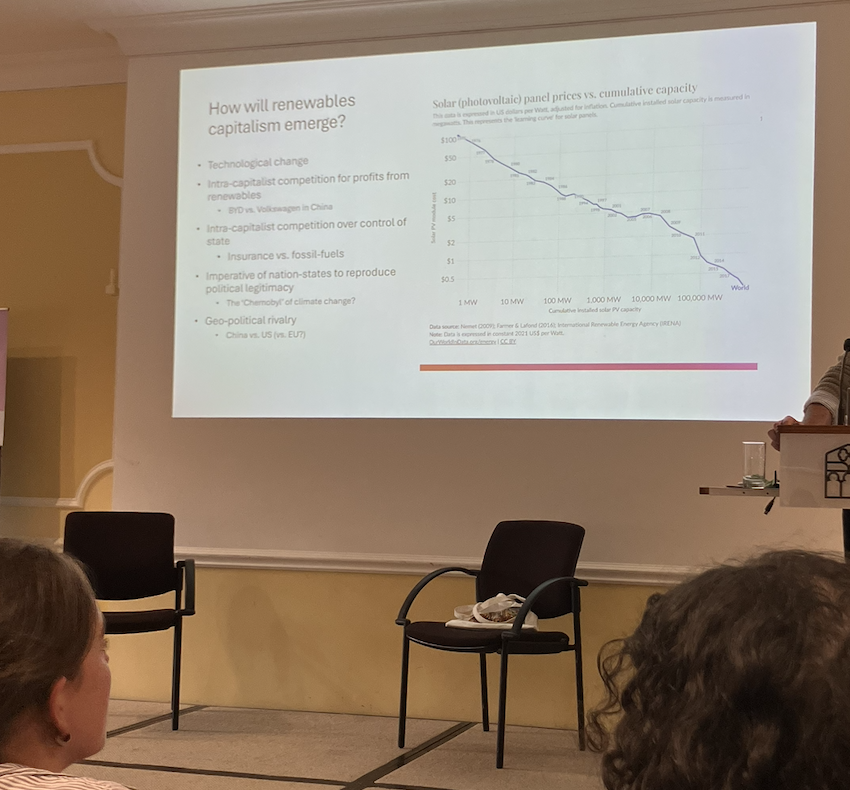
Arsel suggests several drivers could push a similar transition to renewables capitalism:
Technological change: Making renewables increasingly cost-competitive
Intra-capitalist competition for profit: BYD versus Volkswagen in China's electric vehicle market
Intra-capitalist competition over state control: Insurance companies versus fossil fuel companies fighting for political influence
Nation-state imperatives: Governments needing to maintain political legitimacy
Geopolitical rivalry: China versus the West competing for technological and economic dominance
The Developmental Implications
Here Arsel returns to his opening question. Renewables capitalism may solve climate change, but it won't address other socioeconomic inequalities associated with extractivism. More critically, developing countries dependent on fossil fuel exports will experience catastrophic economic shocks when this transition occurs.
If the theory is correct and capitalism does transition to renewables, the developmental implications for fossil-fuel-dependent nations will be severe. These countries face economic devastation as their primary revenue sources evaporate.
If the theory is wrong, Arsel states environmental catastrophe is almost a certainty.
Conclusion
Even in the best-case scenario of a successful transition to renewables capitalism, climate change will cause massive damage to health, lives, and ecosystems. And the distinction between a strong transition (renewables fully replacing fossil fuels) versus a weak transition (renewables complementing and partially replacing fossil fuels) will matter enormously.
Arsel's final point stresses an element mentioned in the beginning that changing composition of the energy matrix has profound political economy implications regardless of how the transition proceeds. Just as coal shaped British politics and society, contributing to Brexit centuries after the Industrial Revolution, the shift to renewables will reshape political economies in ways we're only beginning to understand.
The question isn't whether change is coming, but what kind of change, how fast, and who will bear the costs. For the oil towns of Ecuador and beyond, the answer will determine their very survival.
Reference List:
Reference list entry: Malm, A. (2016). Fossil capital: The rise of steam power and the roots of global warming. Verso.
