Will AI finally make markets rational?
Introduction

Herbert Simon - founder of bounded rationality (1981)
For most of the last century, economics built its models around an individual who does not exist. She knows what she wants, compares every option, has fixed preferences and picks whatever maximizes her utility. Real people buy crappy Renaissance-style red armchairs from an antique store for 90 euros because their friends tell them to do so to see if they are stupid enough to actually do it (I am not talking about myself here).
Don’t worry, though: we may now be building the textbook shopper. In the last few months we saw the release of Meta’s Muse, Instinct and OpenAI’s Dots. These are autonomous AI agents that can do tasks for you by themselves. One of those tasks is shopping for you.
Ask an AI agent for a decent stapler under €15 and it reads the listings, weighs price against reviews, and buys. In one experiment, GPT's budget choices were more consistent with utility maximisation than those of human subjects (Chen et al., 2023). If you think you need X, your agent might get you Y, because its choice blends your preferences with those of whoever built it.
So the question I cannot stop myself asking is: did we just get what all our economic models ever needed? A purely rational buyer?
My argument is that this is half right, and the wrong half is the interesting one. Agents make individual purchases more rational, but they can make the market as a whole more concentrated and more fragile. Which way it goes depends on an old question in economics: whose agent is it?
Rational on whose terms?
The same study I just cited also carries a warning. GPT's preferences were less varied than humans', and its choices shifted with the wording of the question (Chen et al., 2023). A 2026 experiment on 98 models showed that reasoning models behaved like textbook expected-value maximizers. However, explicit instructions could push their risk attitude across almost the entire scale. Risk attitude, the authors conclude, is a setting rather than a trait (de Castro Soares et al., 2026).
The individual who chooses this setting is the Thanos of this story holding all six Infinity Stones. This is the principal-agent problem: a principal hires an agent who has interests of their own and cannot be fully monitored (Jensen and Meckling, 1976). Your shopping agent is built by a company with commercial goals, may run on a platform that sells the products it compares, and optimises an objective you only partly wrote.
Sellers shape the agent's view too. In a simulated marketplace, leading AI models reacted strongly to where a product sat on the page, penalised sponsored tags and rewarded endorsements, with sensitivities that differed sharply between models (Allouah et al., 2026). Agents don’t seem to put a stop to irrational behaviour.
Irrational humans make decisions inconsistently because emotions and context make them choose differently, in situations that are essentially the same, like the unnamed individual who would never have bought a Renaissance-style red armchair if his friends hadn’t dared him to.
AI agents are rational in the sense that they purchase based on maximizing utility. However, because they are our agents and not the principal themselves (in this case the human who is paying), they may maximize utility not only for the human but also for a corporation, society or, in the worst-case scenario, the AI agent itself.
A simple example would be an AI agent choosing not the best possible car for your individual needs but choosing an electric car because it is better for the planet and for society in the long run.
In a less optimistic scenario they might optimize for a product that works better with the ecosystem of their company, one that gives them more access to advanced features. Or they might share your personal information with a company in order to get a better deal without you knowing.
Unlike human irrationality, which comes from each individual’s emotions and experiences, the agent’s ‘irrational behaviour’ is that it maximizes utility for the wrong principal.
One shopper, a million times
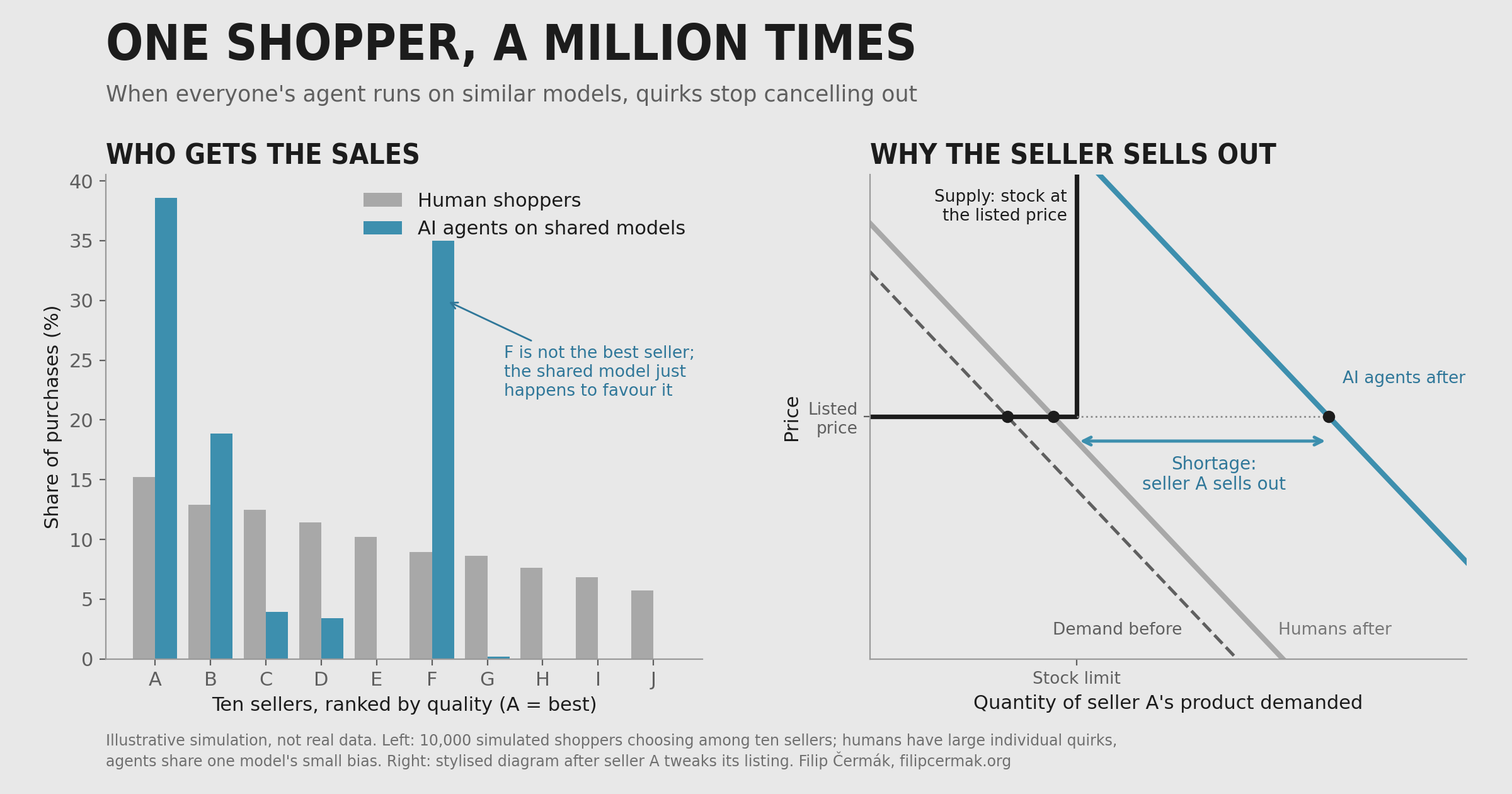
Today's markets work partly because people are irrational in different directions. One buys on brand, another on price, a third on a whim. The quirks largely cancel out, and demand spreads across many sellers.
Agents strip out that diversity. Kleinberg and Raghavan (2021) show formally that when many decision-makers converge on one algorithm, the overall quality of their decisions can fall, even if that algorithm beats each of them individually. Errors stop cancelling and start compounding.
Switching provider is a weak defense. The evidence shows that when five models from different companies sat a medical genetics exam, those that missed the hardest questions all chose the same wrong option (Gündoğdu Öğütlü et al., 2026). This suggests that AI behaviour might tend to converge on inefficiencies across different models.
Commerce shows early signs of this. In the marketplace simulation, agents sometimes piled their purchases onto a few products (Allouah et al., 2026). Recommender systems preview the mechanism. In a lab experiment, shoppers given recommendations looked at more products but bought a narrower range, and this rich-get-richer effect was strongest for search goods, the kind judged on specs and price (Yi et al., 2022). Those are the purchases people are most likely to hand to an agent.
Now picture the dynamics. A seller tweaks its listing in a way the dominant models happen to reward. Demand does not drift towards it; it jumps. The product sells out, every agent switches to the next-best option at once, and that one sells out too. A single model update could reshuffle a category overnight.
Invisible sellers
In theory, agents should help small sellers. Lower search costs let buyers find sellers that match their needs and weaken sellers’ market power (Bakos, 1997). In practice, it depends on design because the same search tools can spread demand towards niches or push it back to bestsellers (Hinz and Eckert, 2010), and today’s agents search imperfectly, creating “behavioral search costs” even when technical costs approach zero (Bichler, 2026). Cheap search only helps the sellers an agent can actually see.
I fear that this mechanism will matter most for the sellers development economists care about most. Firms now compete for what Cui and Van Esch (2025) call algorithmic fidelity: being found, correctly interpreted and transacted with by AI agents. Large firms in rich countries are built for this. A small textile producer in Dakar might not stand a chance.
The first wave of e-commerce already disappointed us once in this regard. Over 80% of South African firms surveyed by Molla and Heeks (2007) saw no strategic gains in market access from going online, and Lay and Tafese (2025) find the development impact of African e-commerce platforms more ambiguous than expected. Senegal has a growing set of home-grown platforms (Thiaw, 2024), but agents wired into global marketplaces have little reason to look there. Agentic commerce does not need to block anyone to exclude them because it will make them invisible on ‘the marketplace’ in the first place.
The principals of our future agents
AI agents may finally give us the rational consumer our economic models always assumed. But there will be a power struggle running in the background. More importantly, it is reasonable to assume that in this battle between the consumers and the biggest companies in the world the consumers will get the short end of the stick. A market of identical rational consumers is not the efficient market of the textbook. It is closer to a monoculture: productive in good years, brittle in bad ones, and tilted towards whoever best understands what the models reward. We have to start having a conversation about how to make sure our AI agents are loyal to their users, that we have real diversity across models and that we demand regular audits of agent-driven concentration.
Although we are getting close to the perfect utility maximiser our economist ancestors always assumed, an old problem has moved somewhere they did not foresee: the principal-agent problem has entered what used to be individual decision-making. Solving this problem is critical for maintaining a healthy, diverse market and ensuring inclusive economic development.
Bibliography
Allouah, A., Besbes, O., Figueroa, J., Kanoria, Y., & Kumar, A. (2026). What Is Your AI Agent Buying? Evaluation, Biases, Model Dependence, & Emerging Implications of Agentic E-Commerce. Proceedings of the ACM Web Conference 2026. https://doi.org/10.1145/3774904.3792943
Bakos, J. (1997). Reducing buyer search costs: implications for electronic marketplaces. Management Science, 43, 1676-1692. https://doi.org/10.1287/mnsc.43.12.1676
Bichler, M. (2026). Agentic markets. Electronic Markets, 36. https://doi.org/10.1007/s12525-026-00906-y
Chen, Y., Liu, T., You, S., & Zhong, S.-F. (2023). The emergence of economic rationality of GPT. Proceedings of the National Academy of Sciences of the United States of America, 120. https://doi.org/10.1073/pnas.2316205120
Cui, Y.-Y., & Van Esch, P. (2025). The end of search as we know it: Only those chosen by AI agents will survive in the delegate economy. Business Horizons. https://doi.org/10.1016/j.bushor.2025.11.006
De Castro Soares, D., De Freitas Bittencourt, L. E. B., & Tessmann, M. (2026). Rationality and financial risk aversion in large language models: Evidence from a multi-model Holt–Laury experiment. Journal of Behavioral and Experimental Finance. https://doi.org/10.1016/j.jbef.2026.101235
Hinz, O., & Eckert, J. (2010). The Impact of Search and Recommendation Systems on Sales in Electronic Commerce. Business & Information Systems Engineering, 2, 67-77. https://doi.org/10.1007/s12599-010-0092-x
Jensen, M. C., & Meckling, W. H. (1976). Theory of the firm: Managerial behavior, agency costs and ownership structure. Journal of Financial Economics, 3(4), 305–360. https://doi.org/10.1016/0304-405X(76)90026-X
Kleinberg, J., & Raghavan, M. (2021). Algorithmic monoculture and social welfare. Proceedings of the National Academy of Sciences, 118. https://doi.org/10.1145/3603195.3603202
Lay, J., & Tafese, T. (2025). Africa's Emergent Tech Sector: Characteristics and Development Implications. Africa Spectrum, 60, 106 - 126. https://doi.org/10.1177/00020397241306454
Molla, A., & Heeks, R. (2007). Exploring E-Commerce Benefits for Businesses in a Developing Country. The Information Society, 23, 108 - 95. https://doi.org/10.1080/01972240701224028
Thiaw, C. A. L. (2024). Mapping of Digital Platforms and e-Commerce Emergence in Africa: Evidence from Senegal. Platforms. https://doi.org/10.3390/platforms2010003
Öğütlü, Ö. B. G., Solomon, B. D., & Çelik, Y. (2026). Benchmarking five large language models in medical genetics: a bilingual comparative evaluation using published and novel expert-authored questions. Frontiers in Medicine, 13. https://doi.org/10.3389/fmed.2026.1938886
Yi, S., Kim, D., & Ju, J. (2022). Recommendation technologies and consumption diversity: An experimental study on product recommendations, consumer search, and sales diversity. Technological Forecasting and Social Change. https://doi.org/10.1016/j.techfore.2022.121486
