The Small Little Theory of Everything
Introduction
In April, Viktor Orbán lost the Hungarian election after sixteen years in power. By the time markets opened on Monday, the interest rate on ten-year Hungarian government bonds had fallen by as much as half a percentage point. A Tisza government meant the release of some €34 billion in frozen EU funds, but in April not a euro had moved and not one reform had been passed. What did happen was a shift in expectation, and the expectation alone repriced a country. All of a sudden investors started believing in the future prosperity of the Hungarian state. But based on what? Hungary discovered no new resources, opened no new factories, registered no new patents. What changed was a belief that the incoming government would curb corruption, strengthen institutions, and make Hungary a predictable partner in Brussels again. The investors weren’t pricing anything Hungary had acquired, but instead what they believed Hungary had become. Call that, for now, a change in the country's Spirit. And yet, it seems that we have very little understanding of what this ‘Spirit’ is. How does it affect our economies? And how do our international organizations, governments and we as individual citizens change to create the Spirit?
Tomáš Sedláček has spent twelve years building an answer. A Yale World Fellow who became Václav Havel's economic advisor at twenty-four, he is best known for Economics of Good and Evil (Oxford University Press, 2011), which traced the moral assumptions buried in economic thinking from Gilgamesh to Wall Street. What Tomáš calls, with deliberate modesty, his Small Little Theory of Everything is the larger project, and I have been lucky enough to spend the past year working alongside him.
Sedláček's answer is deliberately transdisciplinary. He attempts to reverse some of the specialisation that has fragmented our understanding of the world since the Enlightenment and does so by drawing on philosophy, economics, biology, physics and mathematics. Through this, Sedláček tries to explain both the struggle between good and evil and the movement of a bond yield in April. The structure of his theory is a triad: Body, Soul, and Spirit.
The Triad of Body, Soul, and Spirit
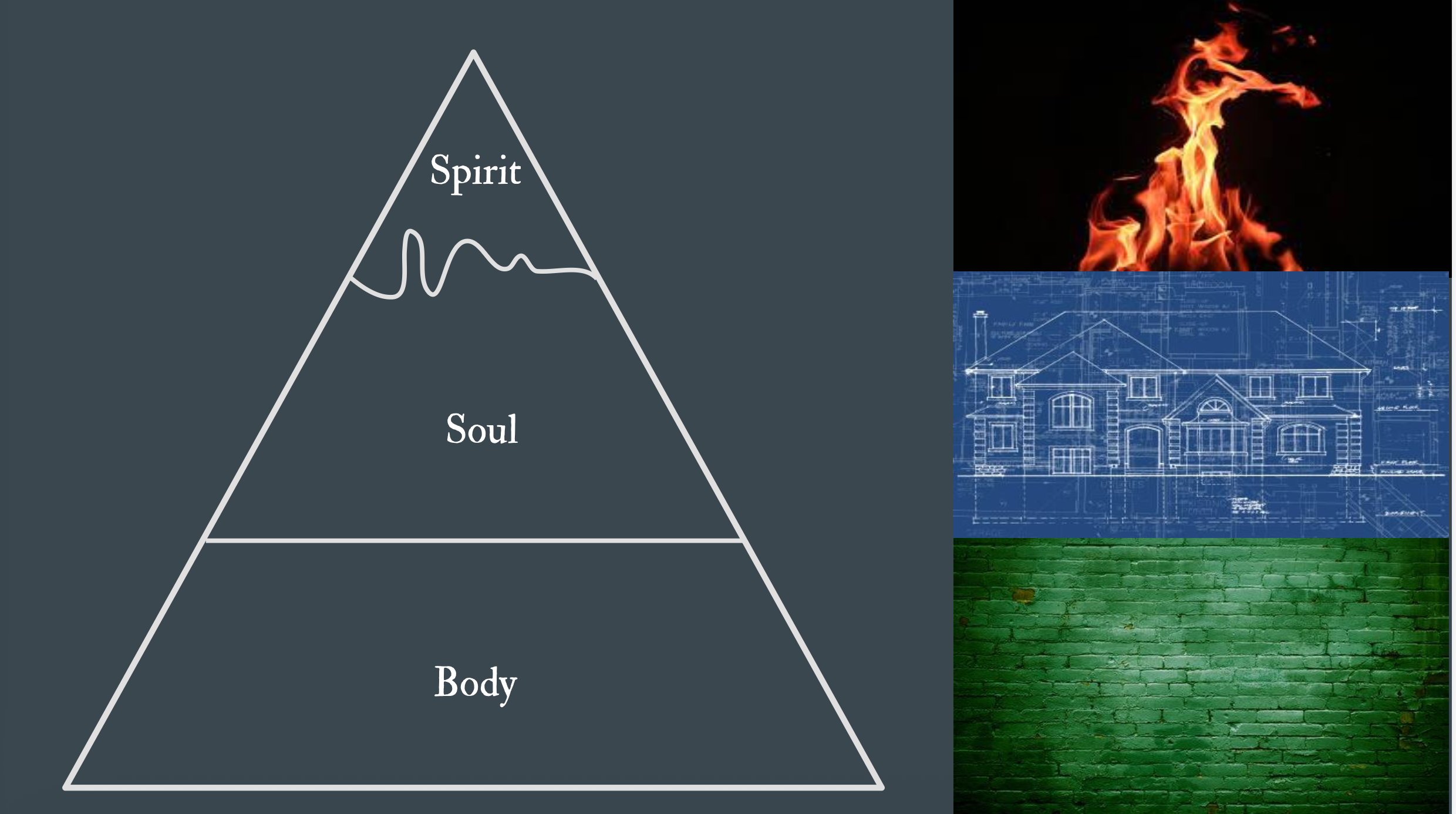
Source: Tomáš Sedláček, "MetaMorphosis (Of Spirit, Soul and Body of Economics)", Semestr Všeho, Praha, 11.10.2025, slide 15
The Body refers to the physical, material dimension: physical objects and, more generally, things one can imagine and in most cases construct or touch.
The Soul is the realm of collectively accepted symbolic structures. These include laws, mathematics, or for example prices. These ‘myths’ are crucial parts of our reality that are immaterial yet objectively real wherever they are recognized.
The Spirit, the most difficult dimension to comprehend, is an often unrecognized force that cannot be reduced to or fully understood through empirical or rational analysis. Words that capture aspects of the spirit include sentiment, meaning, inspiration, and intuition.
Sedláček shows that these dimensions constantly translate into one another. An easy to understand example of this phenomenon from economics is when a central bank adjusts an interest rate (Soul), which alters expectations (Spirit) and ultimately changes the construction of housing estates (Body).
The body
The body is the final stage of creation. After the collective sentiment has put the soul (like monetary transactions and contracts) in motion, buildings get built of concrete, the first iphone is created and tanks cross borders. This is why the built world is a reasonably honest record of what a society believed: cathedrals, motorways, the panel housing blocks that ring every post-communist city. Each is the residue of a Spirit that has long since moved on, left standing because bricks cannot change their minds.
The Soul
A significant part of what Sedláček understands as Soul consists of written and unwritten rules, customs, and institutions. While most of these concepts might evoke constraint and loss of freedom, Sedláček argues that it is precisely through these structures of the Soul that a person can be truly free.
Take the example of grammatical rules in any language. If a person ignores all grammar, the result is not greater freedom of expression but a string of incomprehensible sounds that fails to convey the meaning they intended. We see that poets, who seem able to translate more spirit into their speech than others, achieve this not by removing rules but by adding new ones in the form of alliteration, assonance, or consonance. The Soul is the dimension that allows us to navigate, shape, and communicate the Spirit in the world.
The Spirit
The Untranslatable Nature of Spirit
What is the Spirit, and why is it so difficult to comprehend or communicate to others?
As with many of his more complex insights, Sedláček uses examples from everyday life to explain them, and he does the same when speaking about the Spirit.
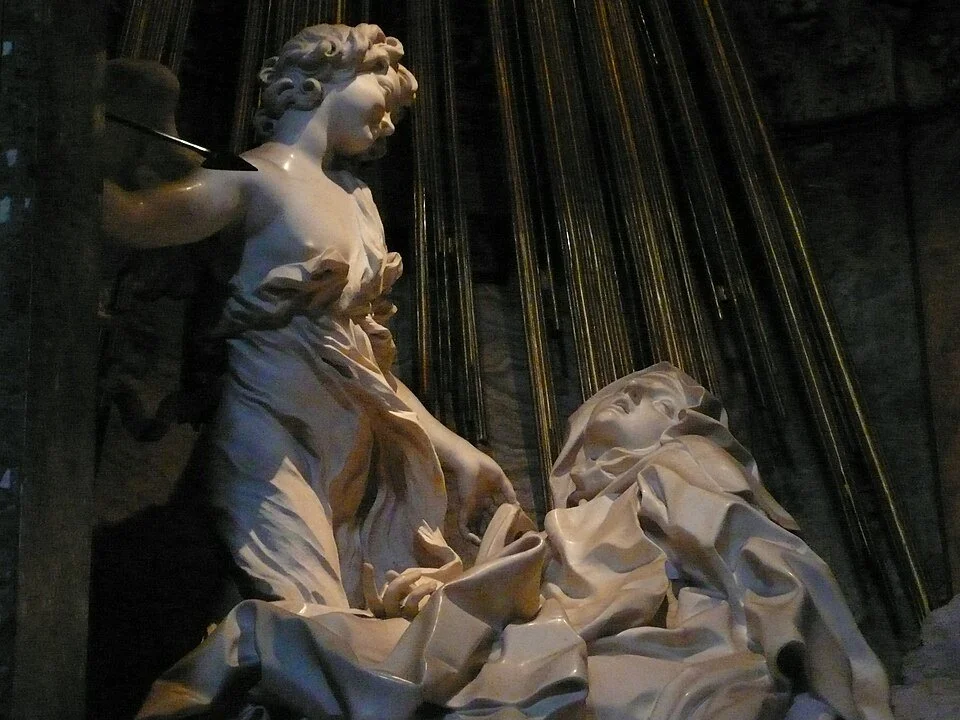
The Ecstasy of Saint Teresa.
Imagine you are upset about something your partner did and you decide to tell them. It often happens that, although the message you wanted to convey was essentially “I love you, and I would appreciate it if you did this differently,” you end up expressing something far harsher and the conversation turns into an argument. Where does the gap between what you intended to say and what you actually communicated come from? In Sedláček’s view, it arises precisely in the moment when we translate the Spirit through the Soul. A precise translation between these two dimensions is impossible.
There are, however, languages that operate exclusively at the level of the Soul. These were made for precise communication and do not resemble our everyday language. For example, in mathematics, if you want to say that the result is 57, you are very unlikely to end up communicating another number. This is because mathematics is a prime example of a purely Soul-based entity. There is no Spirit in mathematics because it was created to ensure clear communication about the physical world (Body). The simplest way to achieve that is through an unequivocal system in which each symbol means exactly one thing.
Human language, however, must do more than convey facts about the world; it must also carry the Spirit. And because the Spirit resides “between the lines” and in the tones of our voice, we often end up ‘apologizing’ for what we say. The word apologize comes from the Greek apo- (ἀπό), meaning “away, from,” and -logia (λογία), meaning “speech, account, explanation.” Thus, when we apologize, we are trying to extract the Spirit of what we meant from the words we actually used.
When we try to understand the Spirit, we have no instruments at hand other than instruments of the Soul such as language, paint, melody, or, arguably, instruments of the Body such as stones, hammers, and chisels.
Art is an attempt to translate Spirit into Soul or Body. Imagine Bernini trying to convey religious ecstasy by creating The Ecstasy of Saint Teresa. The sculpture communicates with the audience through the dimension of the Soul, the expression on Teresa’s face allows us to grasp something of what she is going through, but the true Spirit Bernini wanted to convey can never be fully communicated. Translation of Spirit through Soul is therefore never complete, which is why artists continue creating, trying again and again to express themselves more precisely.
So what is the Spirit, and why is it important?
The Spirit Across Intellectual History
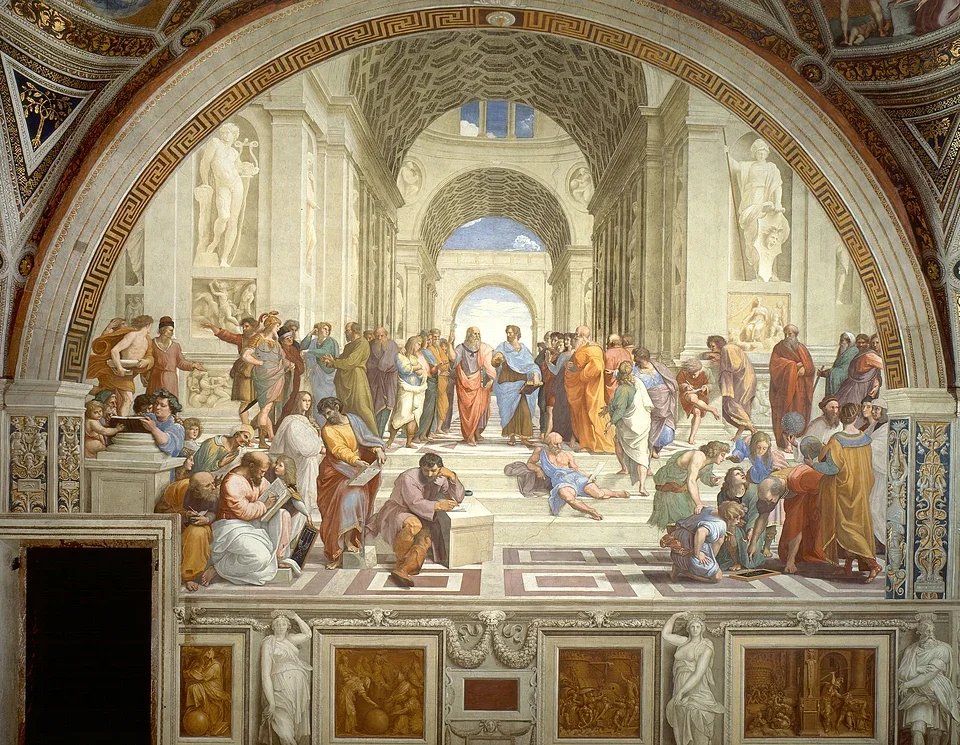
Sedláček’s theory of the Spirit draws on multiple concepts by previous thinkers. For example, the Hebrew Bible speaks of El (אל), typically translated into English as God. Sedláček, however, argues that El can be substituted with the word ‘Spirit’ in the sense he uses it in his theory. Other mentions of this entity can be found throughout Western thought.
In the post-Homer Greek tradition there is a concept of Μοῦσαι (Mousai), or Muses, who embodied the divine source of inspiration behind creativity, insight, and artistic expression. Beyond their mythological meaning, they represented the invisible force that animates human imagination and reveals truths beyond rational analysis.
Later on, Plato writes about the daimónion, an inner guiding voice described by Socrates as the force that warned him against wrong action. It was not a deity or a soul, but an intuitive, non-rational impulse that signaled moral direction without offering logical justification.
Furthermore, Hegel’s concept of Weltgeist (World Spirit) refers to the collective, unfolding consciousness of humanity. Hegel describes it as the universal mind that drives history forward through reason, culture, and self-understanding. It is not an individual spirit but the spiritual force behind historical progress, expressing itself through great events, nations, and thinkers.
The concept that ties these theories to the discipline of economics is Keynes’s concept of “animal spirits,” referring to the spontaneous, non-rational forces such as optimism, fear, confidence or intuition, that drive economic decision-making beyond what logic or calculation can explain.
Sedláček points out that even though economics seeks predictability and animal spirits therefore run against its interests, it is crucial to understand them as a necessary and even desirable part of our economy and our world. He sees these animal spirits as the movers of the economy and the world that we live in. He hints at the fact that animal spirits are, in a way, what makes us human. Even though economic models treat them as residuals marking uncertainty or unpredictability, it is these forces that define our economic behaviour. Without them, the field of economics would not exist.
Keynes himself noted: “If the animal spirits are dimmed and the spontaneous optimism falters, leaving us dependent on nothing but a mathematical expectation, enterprise will fade and die.” (1936)
The Spirit is therefore the irrational and unpredictable part of human beings, driven by motivations that are difficult to explain. And yet, on an aggregate level (Hegel’s Weltgeist), it is this Spirit that seems to have more impact on our world than the Soul or the Body. It is the Spirit that underlies interest-rate levels, stock-market sentiment, or regime changes. Houses are built of bricks and mortar when interest rates are low; people end up sleeping on the streets when the stock market crashes and their savings vanish; and tanks roll into cities when the long-suppressed Spirit of a nation begins to rise beyond what an oppressor can tolerate. The physical and abstract world is shaped by the Spirit, often without us noticing it or believing in it.
We are the only species on this planet capable of ‘manifesting’ our own reality, and we do so to such an extent that most of what our world operates on today is built on this manifestation. The world would collapse without the Spirit, and without our effort to reflect this Spirit through the Soul. This includes our belief in the value of money, laws, reputation, contracts, future returns, nation-states, democracy, or borders. None of these are “real” in the physical sense, and yet these instances of the Soul shape our world precisely through the Spirit that sustains them.
The Cosmic Prehistory of GDP
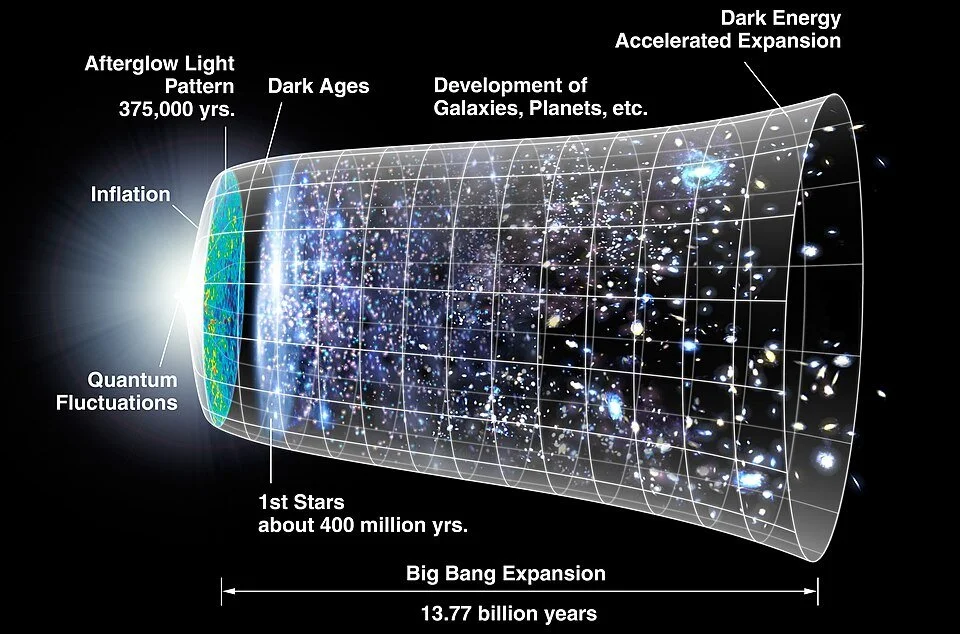
Sedláček extends his theory of Body–Soul–Spirit far beyond economics by placing humanity within the long arc of cosmic history. He asks the question: How can we look at the history of GDP by reaching beyond written history to the beginning of the universe itself? Sedláček begins by conceptualizing wealth as the degree of complexity - the improbability of something coming into being on its own - and the degree of orderedness (entropy) in a system. Under this definition, the universe began in a state of absolute poverty.
Immediately after the Big Bang, the cosmos contained nothing but hydrogen, trace amounts of helium, and microscopic amounts of lithium. There were no stars, no planets, no metals, and no chemistry beyond the simplest atoms. From the perspective of complexity, this was the poorest the universe has ever been.
Over immense stretches of time, the four fundamental forces shaped this barren emptiness. Gravity slowly pulled diffuse clouds of gas together until nuclear fusion ignited, producing light, heat, and the first elements heavier than helium. Only with the births and deaths of generations of stars did the universe gradually accumulate enough structured matter for planets to form out of disks surrounding young suns. One of these planets approximately 4.54 billion years ago was Earth.
A critical point in Sedláček’s theory of origins is that Earth constitutes the “richest” planet in the universe. Sedláček stresses that this is neither a normative claim nor a claim based on our limited empirical knowledge of other planets; instead it is a theoretically grounded argument. Earth contains, in some quantity, essentially the full range of stable elements in the periodic table. In our baryonic universe, no planet can be richer in elemental diversity than Earth, because heavier elements are unstable and quickly disintegrate.
Wealth took its next leap with the emergence of life. To imagine how dramatic this leap was one has to take a moment to imagine the extreme improbability of life coming into being on its own.
Even if we adopt an extremely conservative illustrative estimate for the probability of a planet like Earth forming it would be around 1 in 10²⁰. Fire a rifle in a random direction and your chance of hitting a one-millimetre target 850 kilometres away is roughly that. The origin of life is estimated to be far more improbable, closer to 1 in 10⁴⁰, which is the square of that already extreme improbability. In the same analogy, this would be like firing the rifle blindfolded, in a random direction, and still hitting the same one-millimetre target twice in a row. These numbers are of course rough and illustrative, but they help us understand Sedláček’s core point that life, and especially conscious life, is not just unlikely; it is the most spectacular “improbable order” we know of in the universe.
Nothing in the known universe matches the complexity of even a single-celled amoeba. For most of Earth’s history, life consisted only of such solitary cells; but then, for reasons still not fully understood, cells began cooperating, forming multicellular organisms with specialized tissues, organs, and nervous systems. Life expanded, diversified, and eventually produced human beings. These creatures, as Sedláček calls them, “possessed by Spirit” are capable not only of biological existence but of meaning, imagination, and moral reasoning precisely because they are possessed by Spirit.
For most of human existence, our material conditions were worse than those of many animals. We faced starvation, disease, and constant insecurity. Yet, paradoxically, from this fragile beginning emerged the most dramatic transformation in the history of wealth.
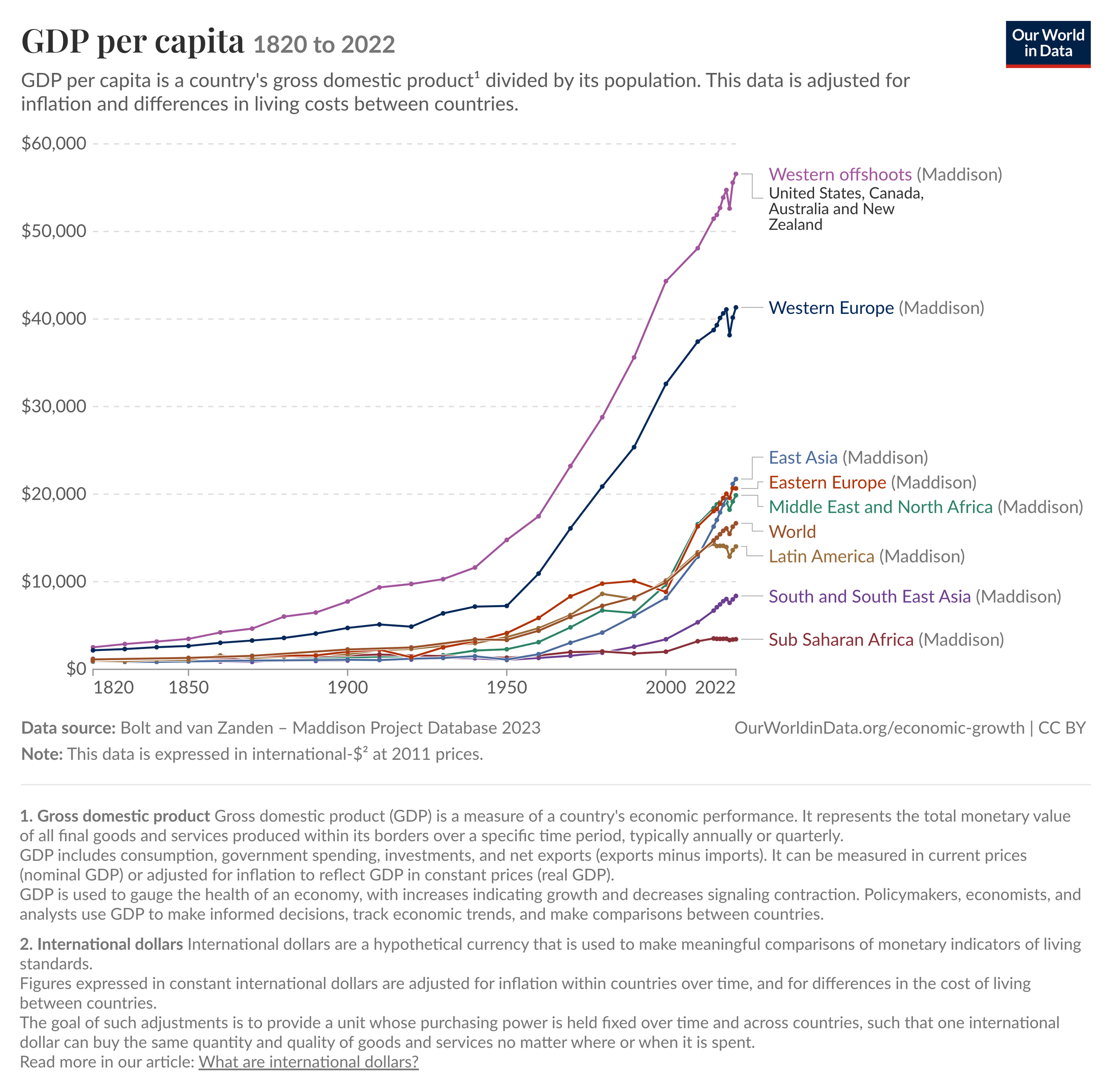
Sedláček connects this to the Great European Economic Miracle, sometimes called the Great Divergence. While earlier civilizations like China reached high levels of development, their growth periodically took off and then receded. The story in Europe is different as it is the only one where this periodic increase in GDP translated into a sustained explosion of innovation, productivity, and material wealth.
He considers several explanations for this success story. Perhaps the most influential comes from Max Weber, whose Protestant Ethic and the Spirit of Capitalism argued that Protestant ethics, especially Calvinist ideas of calling, discipline, and worldly asceticism, created a cultural environment that favored rational organization, hard work, and long-term investment. According to Weber, this sociopolitical climate enabled the spread of capitalism and more meritocratic social structures, giving rise to the prosperity we associate with modern Europe.
Sedláček also acknowledges other theories. Werner Sombart emphasized the role of the Jewish commercial tradition, pointing to linguistic, educational, and diasporic networks that enabled sophisticated finance, trade, and risk-taking across borders. Michael Novak highlighted the contribution of Catholic intellectual heritage, with its emphasis on natural law, moral order, and the dignity of work. More modern theories, most notably those of new institutional economists such as Douglass North, argue that secure property rights, contract enforcement, and political pluralism created “open access orders” in which societies were characterized by free markets and democratic institutions which became catalysts for rapid economic growth.
Viewed through Sedláček’s triad of Body, Soul, and Spirit, these theories reach consensus on a deeper level claiming that societies began to diffuse the “privilege to manifest” across the population, rather than reserving it for kings, priests, or elites. He notes that for the first time in history, citizens began believing that the future could be better than the present. As Yuval Noah Harari observes, ancient mythologies tend to describe golden ages behind us, but in the eighteenth century humanity for the first time believed in golden ages ahead. Michael Munger, furthermore, defines capitalism as ‘time travel through liquidity and equity finance’, underscoring the nature of our economic system as one based on manifestation of the future.
In other words, once the Spirit became constructive and optimistic, it gained the power to reach into the future and lift each generation above the last. Sedláček adds that in the age of artificial intelligence, when AI can act on the Body and the Soul of the world, the role of people is to ensure that the Spirit continues to head toward what is good and not towards what is evil.
the Spirit of International Development
If Sedláček is right, then every discipline – economics and politics, engineering and biochemistry – is ultimately in service of the Spirit. None of them can tell us where it ought to go. That direction is set by the values and expectations we embed in it, and the cultivation of those values may be humanity's greatest task.
Working through this theory has changed how I think about development. I see development as an always ongoing process overarching all other processes. Even development, then, is subject to what we teach children, what our culture praises and condemns, and what religion we believe and how we practise it. In a world growing steadily more materialist, secular and technocratic, the theory is a case for cultivating students rather than training them, for engineers who read philosophy and poetry, and for leaders who understand not only business, economics and negotiation but also know something about beauty, love or even Truth. Those are not ‘nice to haves’ for our economy. On this account they are what our economy is for.
