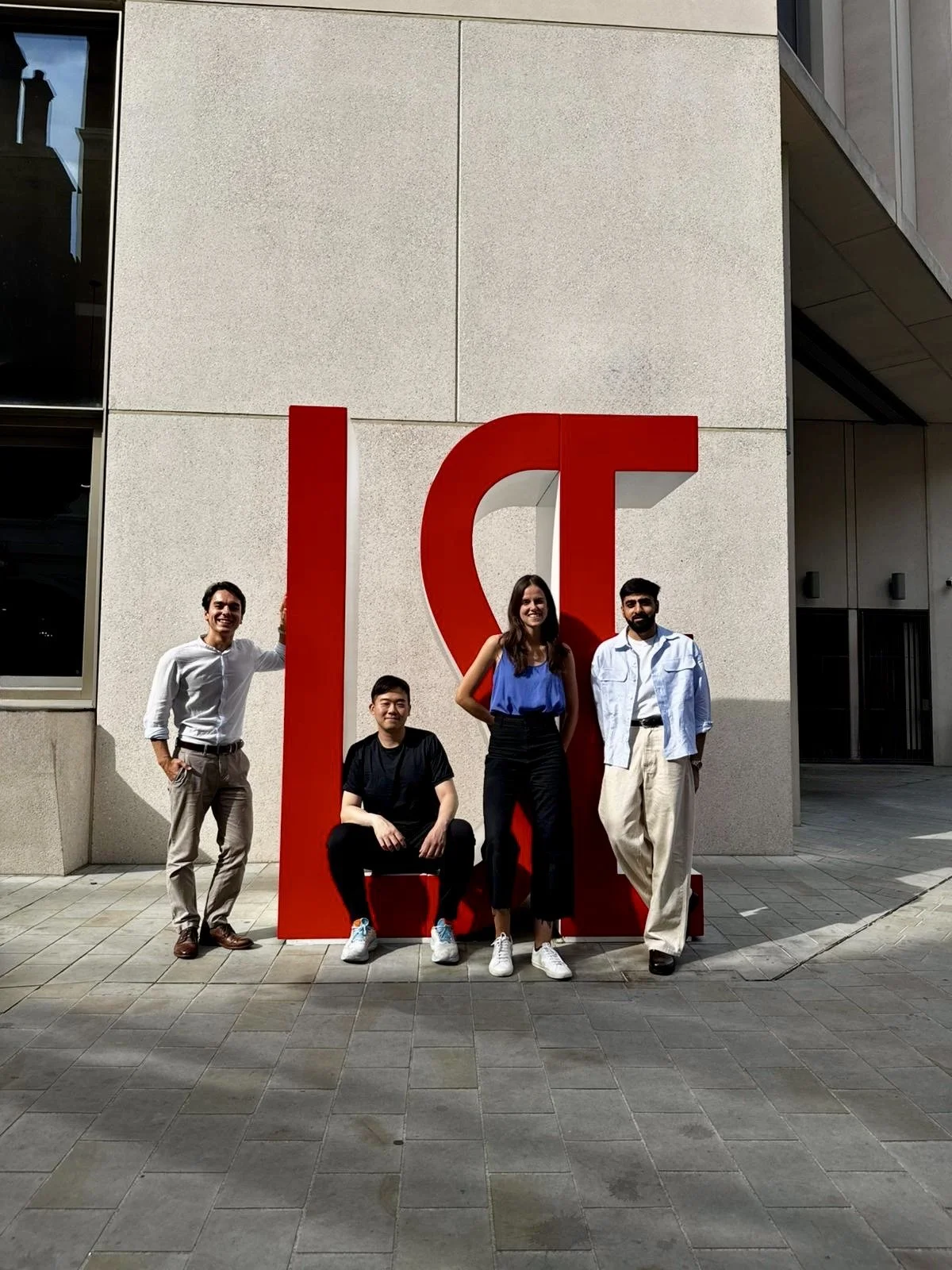
Thanks to all my lovely teammates: Amaan, Lucia and Yinan, it was truly a pleasure working with you
Career update: Earlier this year, as part of my MSc in Development Management at the LSE, I was lucky enough to work on a consultancy project for the Islamic Development Bank (IsDB). It was one of the most useful parts of my master’s degree. It let me dig into two topics: (1) Islamic finance, which had interested me for a while, and (2) Gulf capital and what it means for development in a “post-aid” era, which later became the focus of my dissertation. This post covers the first. Part 2 covers the second. I’m proud that the report earned our team a distinction at LSE.
When I started the IsDB consultancy, I thought I knew what made Islamic development finance different. Unlike conventional finance, Islamic finance prohibits interest (riba). In a world where poor countries keep drowning in debt, that sounded about as close to a solution as it gets.
A few weeks and many hours of research later, I had stopped thinking that. The ban on interest turned out to be the least interesting part of the story. Two other things matter far more, and both seem to get less attention. The first is who carries the risk when things go wrong, which is what this post is about. The second is that Islamic finance might be the best tool we have for moving Gulf money into development, which is the subject of Part 2.
What my consultancy project was actually about
I worked in a team of four on the IsDB’s concessional window, the part of the bank that lends on soft terms to its poorest members. We were asked to rethink how the window raises money, which countries qualify for it, how the money is shared among them, and how the bank shows donors what it achieves.
We benchmarked the IsDB against other concessional lenders, including the World Bank’s IDA, the African Development Bank and IFAD, and drew on banks such as the European Bank for Reconstruction and Development for how to measure impact. We then adapted each design to Islamic finance, for example by using cash waqf (Islamic charitable endowments) in blended finance and proposing a green sukuk (an Islamic bond) that pools climate projects across several of the poorest member countries.
At some point while we were working on the mobilization framework, I realized that the no-riba rule is not what matters most about Islamic finance’s role in development. Concessional lending never pays for itself. Even IDA, the World Bank’s fund for the poorest countries, has to be topped up by donors every three years. Since 2018, though, it has also borrowed on bond markets, stretching each donor dollar about four times (Martinez and Estes 2025).
The IsDB’s concessional window has mostly lent its resources directly, and its loans come back as principal plus a service fee that covers administrative costs, not interest (IsDB 2026). So the pot does not grow on its own, and with every cycle the bank has to go back to its members for new money. To get it, the bank has to prove the last round worked.
For those of us who were supposed to come up with ways to raise that money, it was a painful reality. Unlike at a conventional bank, we were filling a pot with a hole in it. Still, I now think it is the key to understanding Islamic finance through a developmental lens, and to seeing its potential.
The myth of “no interest”
As regular readers will know, I like to be honest about what the evidence says, and here it is clear.
In theory, Islamic finance replaces the loan with a partnership. The funder shares your profits when things go well and takes part of the loss when they don’t. In practice, that almost never happens. Studying Malaysia, Chong and Liu (2009) found that only a negligible share of Islamic bank financing is genuine profit-and-loss sharing, and that the “profit rates” paid on Islamic deposits closely follow conventional interest rates. Miah and Suzuki (2020) looked at 18 Islamic banks in the Gulf and found that about 90 percent of their financing sits in murabaha, a sale with a markup that works much like a loan.
Mahmoud El-Gamal makes the sharpest version of this argument in Islamic Finance: Law, Economics, and Practice (2006). The industry, he argues, has spent decades rebuilding conventional products in old contract forms, with lawyers and scholars paid to certify the difference. One of his examples is the Qatar Global Sukuk, an Islamic bond meant to be backed by real land. Yet S&P rated it exactly like Qatar’s ordinary government debt, because the land played what El-Gamal calls a “ceremonial” role.
I found there to be a good economic reason for this drift. I also want to be clear that, whatever the ethical framework behind Shari’ah-compliant finance, I don’t see this behavior as hypocrisy. A partnership only works if the funder can see the borrower’s real profits, and that level of monitoring is expensive, if not impossible. A fixed repayment, on the other hand, is simpler and cheaper. That helps explain why Beck, Demirgüç-Kunt and Merrouche (2010), comparing banks across 141 countries, find Islamic and conventional banks “more alike than previously thought.”
The same is true of the IsDB. Its concessional loans are repaid on a fixed schedule, no matter what happens to the borrowing country’s economy. The terms are soft. The poorest members get 25 years to repay, including seven years of grace, and pay a service fee to cover costs rather than interest (IsDB 2016). But to an economist, it is still debt in the conventional sense.
Beyond the critique
So is the whole thing just branding, as many claim? I don’t think so. I see three features that make Islamic finance, often lent South to South, a good fit for funding development in low-income countries.
1) Money tied to ‘real things’
Islamic finance has to be attached to a real asset or project, such as a power plant, a road or a hospital. A joint World Bank and IsDB report argues that this makes it a natural fit for infrastructure built through public-private partnerships (PPPs), where the assets can be clearly ring-fenced (World Bank Group and IsDB Group 2017). That is an advocacy report, so we should take it with a grain of salt, but the logic is sound.
2) Debt that doesn’t snowball
In pre-Islamic Arabia, a borrower who couldn’t repay on time was given more time, but only in exchange for a bigger debt. Today, that is international political economy 101. Each missed deadline made the debt grow again, until it had “doubled and multiplied” (Qur’an 3:130, quoted in El-Gamal 2006). The first Quranic verses banning riba targeted exactly this practice. Economists would call it penalty interest compounding on arrears: the deeper a borrower is in trouble, the faster the debt grows. When debt outgrows what a country can repay, most of the gains from growing its economy go to creditors, which weakens the incentive to invest and reform. This problem, known as debt overhang, is one reason heavily indebted countries struggle to develop (Krugman 1988).
The IsDB still charges a small late-payment fee, but it treats that money as income Shari’ah forbids and passes it to a charitable waqf fund instead of keeping it. In 2025, it amounted to about 4,000 Islamic dinars across three cases (IsDB 2026). Banning this kind of penalty doesn’t prevent debt crises, but it removes one of the things that makes them spiral.
3) Risk-sharing as unfinished business
In an IMF paper, Mohsin Khan (1986) argued that the real difference between Islamic and conventional finance isn’t interest but who carries the risk. When a borrowing country is hit by a drought or a commodity crash, it still owes the same on a normal loan, and money that should go to development goes to debt service instead.
Bacha and Mirakhor (2018) propose an Islamic alternative: bonds paid from a project’s earnings, or tied to GDP when the project earns nothing directly, so that payments shrink in bad years. Poor countries could then recover from a crisis instead of suffocating under debt, and pay more once they have recovered.
Unfortunately, this hasn’t worked at scale so far, for two reasons. First, investors charge more to accept the uncertainty. Second, they don’t trust governments to report their own growth honestly. Argentina, for instance, spent years in court after investors accused it of doing exactly that (Strohecker and George 2024).
On the bright side, both problems now have possible answers. Zambia’s 2024 restructuring tied payouts to IMF assessments instead of government statistics, which raises its own credibility questions but is still an upgrade (Strohecker and George 2024). Development banks can also absorb part of the extra cost. I think the IsDB would be a natural fit for this role. Risk-sharing is one of its founding principles, even if its own lending rarely practices it, and it can bring in Gulf investors looking for products that are Islamic in substance, not just in form.
The funding constraint I noticed in the consultancy may fit here too. A bank that has to raise money before it lends, and has to prove results to raise it, is a harder bank to run. But it is also a bank that struggles to pile debt onto its poorest members.
Coming in Part 2
That point about Gulf investors is where I think the bigger story lies. The Gulf has an enormous pool of savings and an Islamic finance industry built to manage it. Yet, as El-Gamal (2006) observed, much of that money was invested in Western markets rather than in poorer neighbors that need infrastructure. So where does Gulf capital go in the developing world today, and could an institution like the IsDB steer it somewhere better? My dissertation tested the first question on 1,777 Gulf investment projects. In Part 2, I’ll share what I found and what it means for the second.
References
Bacha, Obiyathulla Ismath, and Abbas Mirakhor. 2018. “Funding Development Infrastructure without Leverage: A Risk-Sharing Alternative Using Innovative Sukuk Structures.” The World Economy 41 (3): 752–62. https://doi.org/10.1111/twec.12512
Beck, Thorsten, Asli Demirgüç-Kunt, and Ouarda Merrouche. 2010. “Islamic vs. Conventional Banking: Business Model, Efficiency and Stability.” Policy Research Working Paper 5446. Washington, DC: World Bank.
Chong, Beng Soon, and Ming-Hua Liu. 2009. “Islamic Banking: Interest-Free or Interest-Based?” Pacific-Basin Finance Journal 17 (1): 125–44. https://ideas.repec.org/a/eee/pacfin/v17y2009i1p125-144.html
El-Gamal, Mahmoud A. 2006. Islamic Finance: Law, Economics, and Practice. Cambridge: Cambridge University Press.
IsDB (Islamic Development Bank). 2016. Modes of Finance. Jeddah: Islamic Development Bank. https://isdbinstitute.org/wp-content/uploads/2022/04/07-IDB-Modes-of-Finance-ENG-2014.pdf
IsDB (Islamic Development Bank). 2026. Ordinary Capital Resources: Financial Statements and Independent Auditor’s Report for the Year Ended 31 December 2025. Jeddah: Islamic Development Bank. https://www.isdb.org/sites/default/files/media/documents/2026-06/IsDB-OCR%20Financial%20Statements%202025.pdf
Khan, Mohsin S. 1986. “Islamic Interest-Free Banking: A Theoretical Analysis.” IMF Staff Papers 33 (1): 1–27. https://ideas.repec.org/a/pal/imfstp/v33y1986i1p1-27.html
Krugman, Paul R. 1988. “Financing vs. Forgiving a Debt Overhang.” Journal of Development Economics 29 (3): 253–68. https://ideas.repec.org/a/eee/deveco/v29y1988i3p253-268.html
Martinez, Nicolas, and Jocilyn Estes. 2025. “The ABCs of the IFIs: IDA21 Update.” CGD Brief. Washington, DC: Center for Global Development. https://www.cgdev.org/sites/default/files/abcs-ifis-ida21-update.pdf
Miah, Mohammad Dulal, and Yasushi Suzuki. 2020. “Murabaha Syndrome of Islamic Banks: A Paradox or Product of the System?” Journal of Islamic Accounting and Business Research 11 (7): 1363–78. https://doi.org/10.1108/JIABR-05-2018-0067
Strohecker, Karin, and Libby George. 2024. “Analysis: Retro Bonds Return from the ’80s to Speed Up Debt Reworks, but at a Cost.” Reuters, October 23. Republished by Investing.com. https://investing.com/news/economy-news/analysisretro-bonds-return-from-the-80s-to-speed-up-debt-reworks-but-at-a-cost-3677432
World Bank Group and Islamic Development Bank Group. 2017. Mobilizing Islamic Finance for Infrastructure Public-Private Partnerships. Washington, DC: World Bank.
