In Part 1, I argued that the ban on interest is the least interesting thing about Islamic finance, and that its real promise lies in sharing risk. I ended with a question. The Gulf has an enormous pool of savings, so where does that money go in the developing world, and could an institution like the IsDB steer it somewhere better? My MSc dissertation at the LSE tried to answer the first half. This post shares what I found, and then what I think it means for the second half.
Today this question matters more than ever as Western development finance is retreating. Aid from OECD donors fell 23.1 percent in real terms in 2025, the largest annual drop on record (OECD 2026). Meanwhile, outward investment from West Asia, the UN region that includes the Gulf, rose from $60 billion to $142 billion between 2023 and 2025 (UNCTAD 2026). Analysts such as Karen Young (2023) describe Gulf aid, investment and finance as a single tool of economic statecraft and a new form of South-South cooperation, and Gulf governments themselves talk about Arab and Islamic solidarity. If any Southern investor could fill the gap Western aid is leaving, it could be the Gulf.
What I did
Measuring this is harder than it sounds, because no Gulf state publishes detailed data on where its outward investment goes. So I built the analysis on the Orbis Crossborder Investment database, which records individual greenfield projects, meaning new operations and expansions rather than purchases of existing companies, with the destination country and business function of each one. That gave me 1,777 Gulf projects in 136 low- and middle-income countries between 2008 and 2026.
I then looked into which of three patterns Gulf capital follows. The first is the Western commercial pattern, which chases large markets and stable institutions. The second is the Chinese pattern, often described as more tolerant of weak governance and more drawn to natural resources. The third is something distinctly Gulf.
What I found
It behaves like Western commercial capital. Larger, richer markets with stronger rule of law and less corruption attract more Gulf projects. Natural resources don’t: resource rents have no effect, and mining accounts for just 1.7 percent of projects. On the two things that separate the Western and Chinese patterns, Gulf capital sits closer to the Western one.
With one distinctive twist: a co-religionist premium. Compared with similar countries outside the Organization of Islamic Cooperation (OIC), Arab League members receive about 5.3 times as many Gulf projects, and other OIC members about 1.9 times as many. Earlier research found a similar ordering in Arab aid (Neumayer 2003). What surprised me is finding it outside aid, spread across the decisions of 580 separate investors. In the Gulf the line between state and private capital is blurry, and at least four in ten of the projects I could classify are state-linked. But the retail and hotel groups at the heart of the portfolio are mostly privately run, so the premium probably isn’t just government policy passed through state firms, though I couldn’t test that directly. My data can’t fully separate religion from language, diaspora ties and geography, so I read this as an affinity premium rather than proof that faith drives investment.
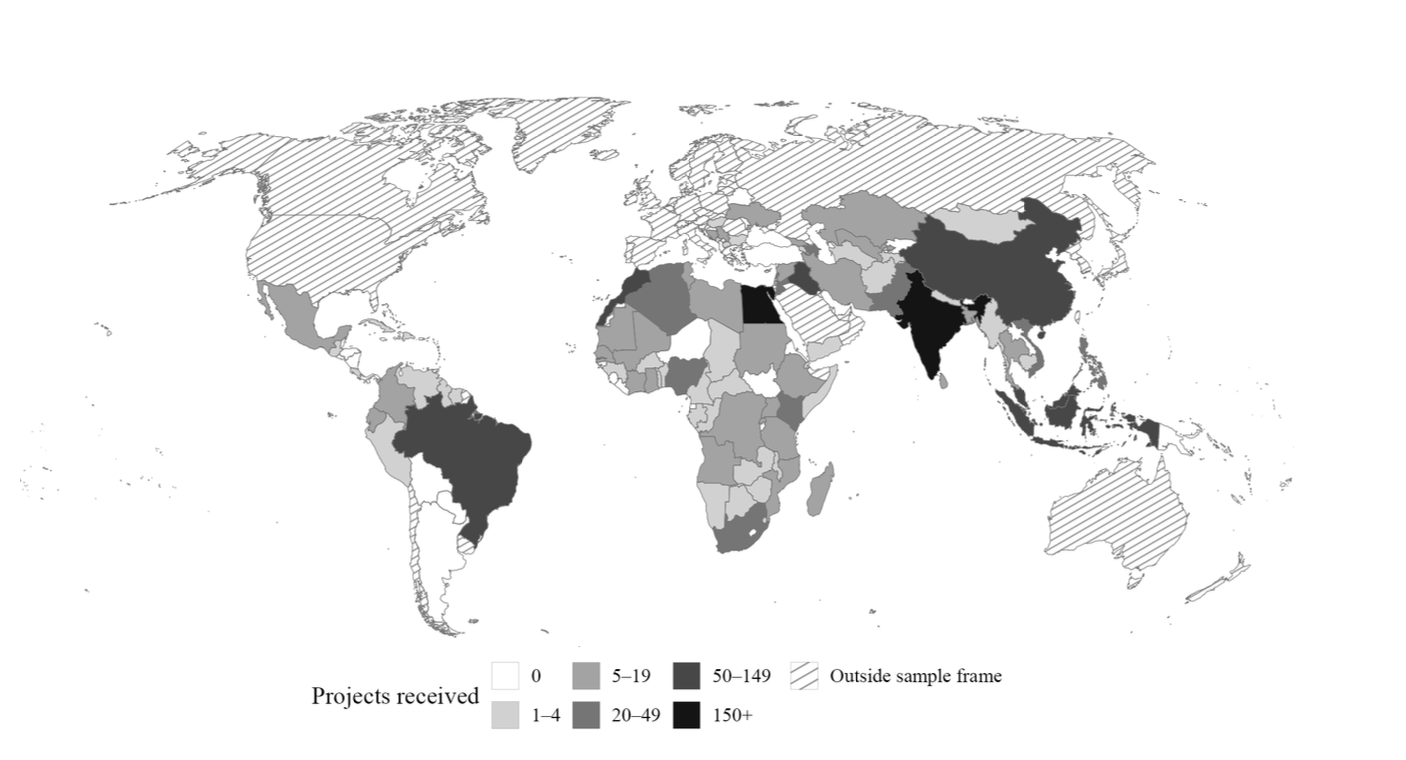
Figure 1. Gulf greenfield projects received by country, 2008–2026. Hatched areas are outside the sample (mostly high-income countries and the Gulf states themselves). Source: author’s analysis of Orbis Crossborder Investment data.
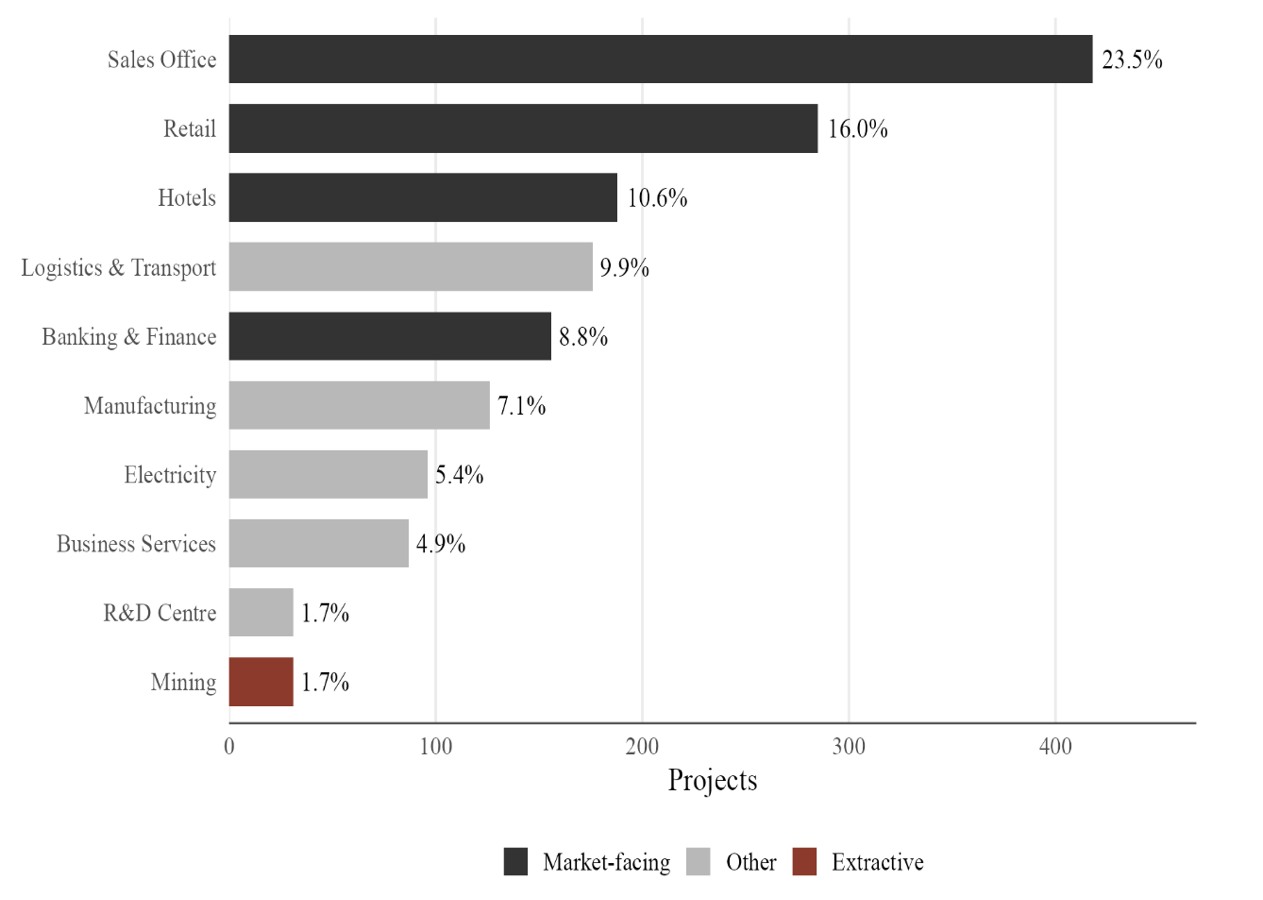
Figure 2. The ten most common business functions of Gulf greenfield projects, share of all projects, 2008–2026. Source: author’s analysis of Orbis Crossborder Investment data.
The smallest and poorest markets get almost nothing. Forty-four of the 136 countries received no Gulf projects at all. Their median population is 2 million, and half of them are upper-middle income, so what keeps them out is the lack of a market more than poverty alone. Higher income predicts both whether a country receives any Gulf projects and how many it receives.
What arrives is mostly shops, offices, hotels and banks. Sales offices, retail outlets, hotels and banking make up 58.9 percent of all projects. That is investment whose development effect runs through consumption and market structure, not through the infrastructure and productive capacity that development finance usually supplies.
Put simply, Gulf greenfield investment is commercial capital with a co-religionist premium. It has not reached the economies now losing concessional finance (Čermák 2026).
Egypt: the exception that proves the rule
I found that Egypt is where the story gets interesting. It received 237 Gulf projects, second only to India’s 330, and of the two largest recipients it was the only one where Gulf capital entered a sector that looks like what development finance supplies: power generation. Egypt received 15 electricity projects, while India received none.
But look at how that happened. Egypt’s first round of renewable energy projects largely failed in 2016. Only 3 of 110 qualified applicants reached financial close, delivering 150 megawatts against a target of 2,000 (Norton Rose Fulbright 2015; IJGlobal 2016). A foreign exchange shortage, combined with a rule confining disputes to arbitration in Cairo, drove the development lenders away (KPMG 2017; IJGlobal 2017). The second round closed in October 2017, after the currency was devalued and the government accepted arbitration abroad. Thirty projects reached financial close, and the IFC and the EBRD financed 29 of them (IJGlobal 2016, 2017). The Ministry of Finance guaranteed the buyer’s payments, and the central bank guaranteed conversion of half the revenues into foreign currency (Sharkawy & Sarhan Law Firm 2015).
Only then did the Gulf champions arrive. Three of the five investors behind Egypt’s 15 electricity projects are sovereign-linked: ACWA Power, part-owned by Saudi Arabia’s Public Investment Fund, and Abu Dhabi’s Masdar and Mubadala. The Egyptian state and Western development banks absorbed the risk, and Gulf capital followed them into a strategic sector. It did not lead the way. Even then, electricity made up only 6.3 percent of Egypt’s Gulf projects (Čermák 2026).
Daniela Gabor (2021) calls this model “development as de-risking”: the state and its partners build a safety net that makes development investable for private capital. Egypt wasn’t passive in this. Its government built the guarantees, gave up the arbitration seat and courted the capital it wanted in the sector it chose. But the result was a field of five Gulf investors in the Egyptian electricity sector, three of them state-backed, and long-term obligations partly in a currency Egypt has to buy.
Limitations
A few honest caveats before drawing conclusions. I counted projects rather than their value, because the investment figures in the database are mostly modeled rather than disclosed, so a sales office and a refinery each count as one. The data cover only greenfield projects, which leaves out most of what Gulf sovereign wealth funds do. Those funds account for over 80 percent of Gulf outward investment by value, and they mostly invest through equity stakes (Xin and Korniyenko 2025). The United Arab Emirates alone accounts for 72 percent of the projects, so the results are substantially Emirati. And the design shows where capital went, not why it went there.
The hidden opportunity
So Gulf companies’ investment is no replacement for retreating aid as it skips the smallest markets and doesn’t flow in developmentally strategic ways. But the Egypt case points to something more useful than this simple observation. In the one sector where I could trace the sequence, Gulf capital followed de-risking. It is a single case, the followers were mostly state-backed, and since Gulf investors skip small markets rather than risky ones, de-risking may change what they do more than where they go. However, it suggests that if Gulf capital follows whoever takes the first risk, then whoever takes that risk can help steer it. Here is the most interesting and potentially impactful implication of what I found, and the part I’d most like your thoughts on if you work in this space.
The money is there. In 2006, El-Gamal found that the Gulf’s homegrown Islamic finance providers had become mainly asset gatherers. They collected Gulf savings, mostly to invest them in Western markets. In theory, capital should earn more where it is scarce, yet little of it flows to poor countries. The leading explanation is weak institutions, which add risk that eats up the extra return (Alfaro, Kalemli-Ozcan and Volosovych 2008). My results partly fit that story. Gulf investors skip smaller, poorer markets altogether, and among the countries they do enter, they put more where the rule of law is stronger. Closing the gap between potential returns and bankable ones is exactly what multilateral development banks are for.
In Egypt, Western banks did that job. I think the IsDB could do it for Gulf capital in the sectors Gulf investors currently pass over in its member countries. It ‘speaks the language’ Gulf investors need, and it can structure deals in a form they are able to join. It has done so before. The IsDB Group was the mandated lead arranger for the Manisa Training and Research Hospital, a public-private partnership in Turkey where about 80 percent of the funding commitments came through Islamic tranches, and it co-financed two wind projects in Pakistan with the Asian Development Bank under an Islamic structure (World Bank Group and IsDB Group 2017). The co-religionist premium in my data suggests Gulf investors are already more at home in the IsDB’s member countries. A development bank can’t make a small market bigger, but it can make a risky one bankable.
There is also a reason this job may fall to the IsDB rather than to the Gulf states themselves. In Egypt, Gulf sovereign vehicles took the de-risked position rather than creating it, which leaves me doubtful that they will start taking on the first risk on their own (Čermák 2026). A multilateral bank with Gulf shareholders, Islamic finance structures and a development mandate is a more natural candidate.
I want to be careful here, because “catalyzing private capital” is the most overused phrase in development finance, and the evidence is mixed. Using loan-level data from 1993 to 2017, Broccolini and colleagues (2021) find that each dollar of development bank lending brings in about seven dollars of bank credit over three years. The poorest countries see far less of this. An OECD and UNCDF report found that only 6 percent of the private finance mobilized by development finance between 2012 and 2017 went to the least developed countries (OECD and UNCDF 2019). At ODI, Attridge and Engen (2019) found that each public dollar in blended deals mobilized just 37 cents of private finance in low-income countries, and concluded that “billions to billions” is more realistic than “billions to trillions.”
So the IsDB is not a magic multiplier. But it may be the only institution positioned to open a door for large amounts of Gulf capital that other development banks can’t open at all. That matters more now that Western aid is retreating, and in recent years donors have leaned on multilateral institutions to offset cuts to their own bilateral aid (OECD 2026). In this world, regional development banks will play a crucial role. Unlike in the seventy-year era of aid that now seems to be ending, they will have to act as strategic risk-takers, using their understanding of the regional context to steer private capital toward development. The IsDB has distinctive Islamic finance structures, rich shareholders on one side and members with large development potential on the other. If it can turn those into not only a catalytic role, but one that looks at the evidence at a macro scale and steers that capital where it has the most developmental potential, it could significantly shape the development of its region for the next seventy years.
If you work on this, at the IsDB or anywhere else, I’d love to hear your thoughts and critiques.
References
Alfaro, Laura, Sebnem Kalemli-Ozcan, and Vadym Volosovych. 2008. “Why Doesn’t Capital Flow from Rich to Poor Countries? An Empirical Investigation.” Review of Economics and Statistics 90 (2): 347–68. https://doi.org/10.1162/rest.90.2.347
Attridge, Samantha, and Lars Engen. 2019. Blended Finance in the Poorest Countries: The Need for a Better Approach. London: ODI. https://cdn.odi.org/media/documents/12666.pdf
Broccolini, Chiara, Giulia Lotti, Alessandro Maffioli, Andrea F. Presbitero, and Rodolfo Stucchi. 2021. “Mobilization Effects of Multilateral Development Banks.” The World Bank Economic Review 35 (2): 521–43. https://doi.org/10.1093/wber/lhz049
Čermák, Filip. 2026. “Commercial Capital with a Co-Religionist Premium: Gulf Greenfield Investment and the Limits of Substitution for Development Finance.” Unpublished MSc dissertation, London School of Economics and Political Science.
El-Gamal, Mahmoud A. 2006. Islamic Finance: Law, Economics, and Practice. Cambridge: Cambridge University Press.
Gabor, Daniela. 2021. “The Wall Street Consensus.” Development and Change 52 (3): 429–59. https://doi.org/10.1111/dech.12645
IJGlobal. 2016. “Take Two for Egypt’s Solar FIT.” https://infrastructure.greenstreet.com/articles/102251/take-two-for-egypts-solar-fit
IJGlobal. 2017. “Egypt Closes Solar FIT 2 at Half the Price.” https://infrastructure.greenstreet.com/articles/130622/egypt-closes-solar-fit-2-at-half-the-price
KPMG. 2017. Renewable Energy in Egypt: The Green Opportunity. London: KPMG. https://assets.kpmg.com/content/dam/kpmg/uk/pdf/2017/03/renewable-energy-in-egypt-the-green-opportunity.pdf
Neumayer, Eric. 2003. “What Factors Determine the Allocation of Aid by Arab Countries and Multilateral Agencies?” The Journal of Development Studies 39 (4): 134–47. https://doi.org/10.1080/713869429
Norton Rose Fulbright. 2015. “Egypt’s Feed-in Tariff Program: Ready, Set….” Project Finance NewsWire, February. https://www.projectfinance.law/publications/2015/february/egypt-s-feed-in-tariff-program-ready-set/
OECD. 2026. “International Aid Fell Sharply in 2025, Says OECD.” Press release, April 9. https://www.oecd.org/en/about/news/press-releases/2026/04/international-aid-fell-sharply-in-2025-says-oecd.html
OECD and UNCDF. 2019. Blended Finance in the Least Developed Countries 2019. Paris: OECD Publishing. https://doi.org/10.1787/1c142aae-en
Sharkawy & Sarhan Law Firm. 2015. Egypt’s Feed-in Tariff Program: Briefing on Project Bankability and Finance Aspects. Cairo. https://sharkawylaw.com/wp-content/uploads/2021/01/Egypt_FiT_Program.pdf
UNCTAD (United Nations Conference on Trade and Development). 2026. World Investment Report 2026: International Investment in a Turbulent Era. Geneva: United Nations. https://unctad.org/system/files/official-document/wir2026_en.pdf
World Bank Group and Islamic Development Bank Group. 2017. Mobilizing Islamic Finance for Infrastructure Public-Private Partnerships. Washington, DC: World Bank.
Xin, Weining, and Yevgeniya Korniyenko. 2025. “Gulf Cooperation Council Diversification: The Role of Foreign Investments and Sovereign Wealth Funds.” IMF Working Paper. Washington, DC: International Monetary Fund. https://www.imf.org/en/publications/wp/issues/2025/09/05/gulf-cooperation-council-diversification-the-role-of-foreign-investments-and-sovereign-569546
Young, Karen E. 2023. The Economic Statecraft of the Gulf Arab States: Deploying Aid, Investment and Development Across the MENAP. London: I.B. Tauris.
