Growth Diagnostics in Practice, Part 3: Power Cuts and Paper Barriers

This is Part 3 of a series applying the Hausmann-Rodrik-Velasco growth diagnostics framework to Senegal.Part 0 introduced Rodrik's challenge to development economics and the diagnostic tree. Part 1 introduced the diagnostic overview of Sengl. Part 2 argued that human capital is not Senegal's binding constraint: the problem is not a shortage of skills but a productive structure that cannot absorb them.
So, what is actually holding Senegal back?
This post is a little different from the first two. Last time I showed you the method through which we tested for each of the possible constraints in the diagnostic tree to find out which of the possible constraints are the binding ones for Senegal’s economy. Today, I want to share the full diagnostic report our group produced. It is a 70-page applied growth diagnostics of Senegal, completed in April 2026 with my teammates who I also want to thank for an amazing cooperation Jaquelina Yu, Narmin Isgandarli, Marta Meler Tarlowski, and Veronica Yuxuan Li - a team I was lucky to work with!
The report is linked at the bottom. What follows is the main take-aways and 4 policy recommendations to effectively solve the identified binding constraints.
One and a half of binding constraints: Electricity and Labour regulations
The report identifies electricity as Senegal's primary binding constraint, with labour regulation as a second-order constraint.
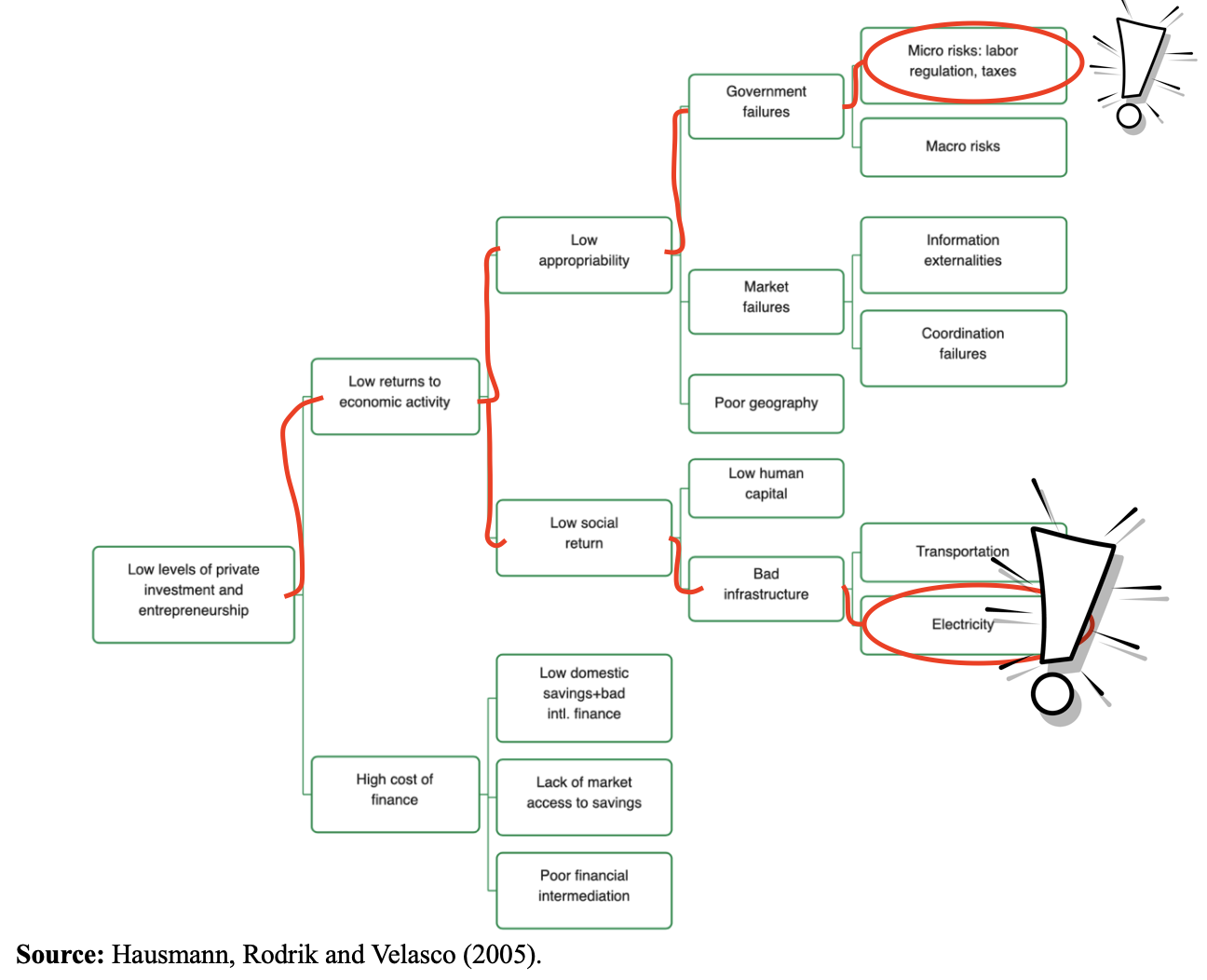
Senegal's access rate of 74% is broadly in line with regional peers. So why does it hinder Senegal’s economy more than its peers? The real issue is cost and reliability at the firm level. 53.5% of manufacturing firms cite electricity as their biggest obstacle, far above Kenya (17.6%) or Côte d'Ivoire (3.3%). Even more telling is the generation cost gap. SENELEC's generation cost of $0.283/kWh exceeds its retail tariff by $0.122, a negative spread unmatched by any peer in the comparison group. The state covers this gap through energy subsidies that reached 4% of GDP in 2022. Gross electricity demand has exceeded supply since 2002. Around 80% of Senegalese firms run their own generators, and a third report having delayed or avoided investments in new machinery specifically because of energy uncertainty.
This is a major problem for increasing economic complexity and kickstarting growth. The constraint does not just punish firms that already exist. It suppresses the entry of higher-value activities before they appear.
Labour regulation is our second constraint, though one that operates differently. Senegal's Labour Code imposes significant friction on hiring and firing, raising the cost of formal employment. We saw the results of this show up in firm size. Senegal records the lowest share of medium-sized firms of any comparator, and large firms account for only 19% of enterprises, versus 39.4% in Vietnam. Firms respond by staying small and informal, or relying heavily on fixed-term contracts. That 54.8% of formal employment contracts are fixed-term is itself a symptom of this dynamic.
Signal versus Noise: What the diagnostic ruled out
Working through the HRV tree forced us to be explicit about what is not the binding constraint. Part 2 of this series already covered human capital. The full report also assesses transportation, finance, taxation, and macroeconomic risks. None passes the full sequence of diagnostic tests.
The macroeconomic picture was the most analytically challenging. Senegal's actual debt-to-GDP ratio was revised upward to around 132% following the 2025 Cour des Comptes audit, which revealed systematic underreporting averaging 5.6 percentage points of GDP annually. Of course, this is serious. But the report argues that fiscal fragility is not currently a binding constraint on private investment. Private investment grew from 17.3% to 29.7% of GDP between 2014 and 2023, with no clear evidence of crowding out (mostly due to oil discovery). The report acknowledges the debt situation operates as a meta-constraint, narrowing the government's capacity to address electricity, which is the constraint that actually suppresses growth.
The Syndrome
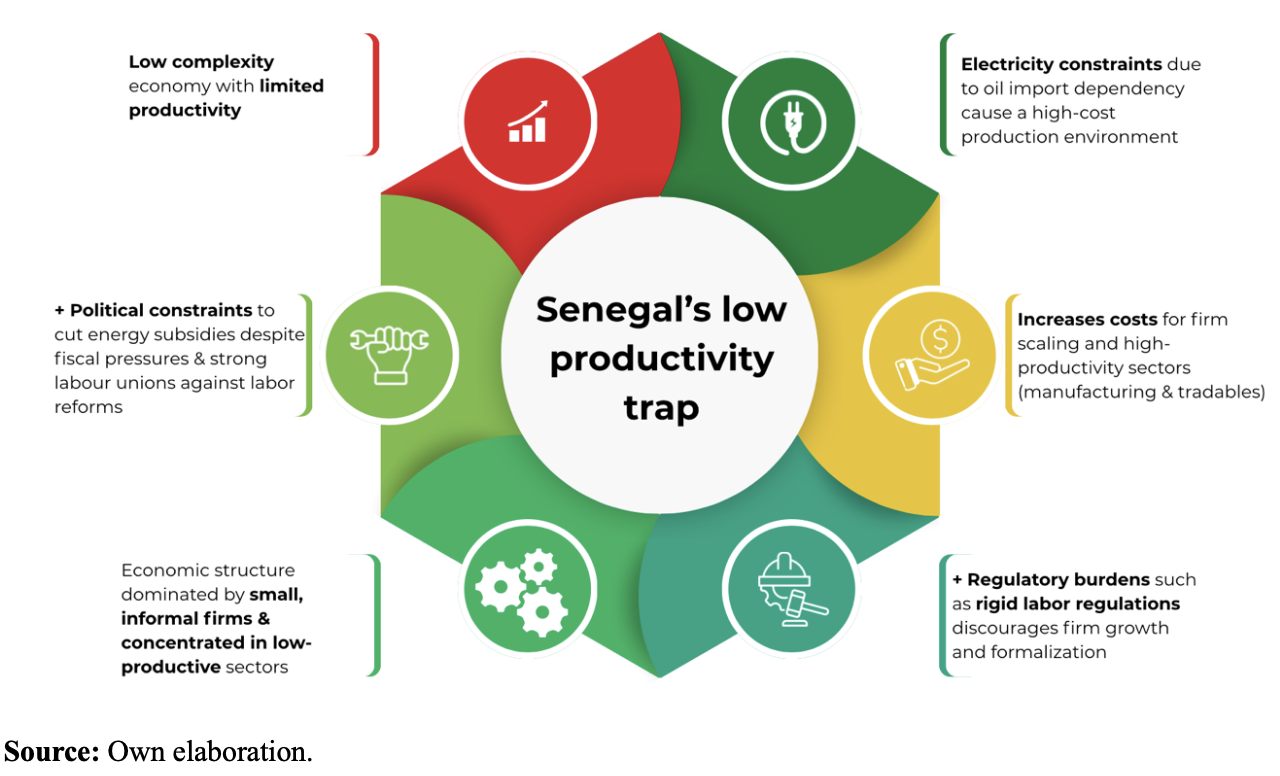
What makes Senegal's situation hard is that these constraints reinforce each other. High electricity costs push firms toward costly self-generation and away from investment. Rigid labour regulation pushes firms toward informality and small scale. Informal, small firms have little incentive to invest in productivity. Low productivity limits taxable output, which constrains fiscal space for infrastructure reform. The political economy of subsidies, sustained by urban constituencies, makes tariff reform difficult. The result is chronic stagnation.
Therapeutics: our 4 prescriptions
The four recommendations follow in an intentional order:
First, protect and accelerate the gas-to-power transition through a ring-fenced infrastructure authority, modelled on Morocco's MASEN, to reduce generation costs from around $0.34-0.38/kWh toward $0.15-0.20/kWh.
Second, scale Special Economic Zone infrastructure to create formal employment using the labour flexibility already embedded in the 2017 SEZ law, avoiding the political infeasibility of direct Labour Code reform.
Third, implement a phased SENELEC reform following the Côte d'Ivoire hybrid model rather than Kenya's simultaneous unbundling.
Fourth, link energy savings to formalization through a direct incentive package, using subsidy savings to reduce the cost of crossing the informal-formal threshold.
We point out that the sequencing matters as much as the content. Each step creates the fiscal and institutional conditions for the next. Electricity comes first because it is the precondition for everything else.
It covers the peer selection methodology, the full diagnostic tree with all seven candidate constraints, the political economy analysis, and the complete policy recommendations.
This series will continue with its last part in which I will show you my own political economic analysis of Senegal’s international borrowing and barriers to broadening domestic revenue base. Stay tuned!!
